Real-World Uses, Limits, and When to Use a TEE
A TEE is one component in a complete system
A TEE can provide a protected place for computation. It does not secure every stage of the data lifecycle.
A complete system may still need:
- Client-side security
- Network encryption
- Authentication
- Access control
- Key management
- Safe storage
- Output controls
- Privacy-aware logging
- Software updates
- Incident response
- Availability planning
- Secure deletion
A TEE cannot compensate for an application that copies every private input into an unprotected log.
Web2 use cases
Confidential cloud workloads
An organization can run a sensitive backend inside a confidential virtual machine. The goal may be to reduce the cloud operator's ability to inspect application memory, database contents during processing, private keys, proprietary code, and intermediate computation state.
The guest operating system remains part of the trusted boundary.
Private AI inference
A user sends a private prompt to an AI service. The service may use a confidential VM, confidential GPU, remote attestation, attested secure channel, protected model weights, and encrypted output.
The TEE may protect prompt and model data during inference. It may not hide request timing, response timing, input size, output size, user identity, billing records, or network metadata.
Data clean rooms
Several organizations can send private datasets to an approved analysis program. The program runs inside a TEE and returns aggregate results.
The design must still prevent the output from revealing individual records. Techniques such as minimum group size, query limits, differential privacy, output review, and rate limiting may be required outside the basic TEE protection.
Biometric processing
A secure subsystem can protect biometric templates and comparison operations. Apple's Secure Enclave is used as part of the protected architecture for biometric authentication and device-bound key operations.
Secure key operations
A TEE can restrict how a key is used — allowing signing approved messages, decrypting approved records, deriving session keys, performing authentication, or releasing a key only after attestation. The application must enforce a safe policy around the operation.
Web3 use cases
Private order processing
Users encrypt orders before sending them to a TEE-based matching system. The TEE processes the orders before publishing a settlement result.
Possible benefits: reduced order leakage, reduced front-running opportunities, private matching logic, protected trading strategies.
Remaining problems may include operator censorship, rollback, incorrect matching code, side-channel leakage, availability, attestation centralization, and public settlement metadata.
TEE-backed oracle computation
An oracle can collect external information and process it inside a TEE. Attestation may show which oracle code was loaded.
It does not prove that the external data source was truthful, the network response was not manipulated, the output logic was economically safe, or the operator cannot withhold the result.
Off-chain coprocessing
A blockchain application can send a heavy computation to a TEE and later receive a signed result. The TEE can provide fast general-purpose computation.
The blockchain still needs a policy for accepting attestation, handling updates, rejecting revoked hardware, preventing replay, managing unavailable operators, and resolving conflicting outputs.
Protected wallet and validator keys
A TEE can protect a private key from direct extraction. The application must still prevent unauthorized signing requests, conflicting signatures, policy bypass, rollback of signing state, duplicate recovered keys, and malicious transaction construction.
Important TEE limitations
Side channels — A TEE may prevent direct reads while leaking information through cache activity, timing, page access, branch behaviour, request size, response size, and resource usage.
Malicious trusted code — Attestation can prove that particular code was loaded. It does not prove that the code is safe.
Host-controlled availability — The host may stop, delay, restart, or isolate the TEE.
Output leakage — A protected computation can produce an unsafe result.
Endpoint compromise — A secure TEE cannot protect data already exposed on the user's device.
Vendor dependence — Many TEE attestation systems depend on certificate and endorsement infrastructure operated by hardware or cloud vendors.
Firmware and microcode risk — Hardware guarantees often depend on firmware and microcode that can contain vulnerabilities.
State rollback — Encrypted persistent state may be replaced with an older valid version.
Physical attacks — Not every TEE is designed to resist attackers with direct physical access and specialized equipment.
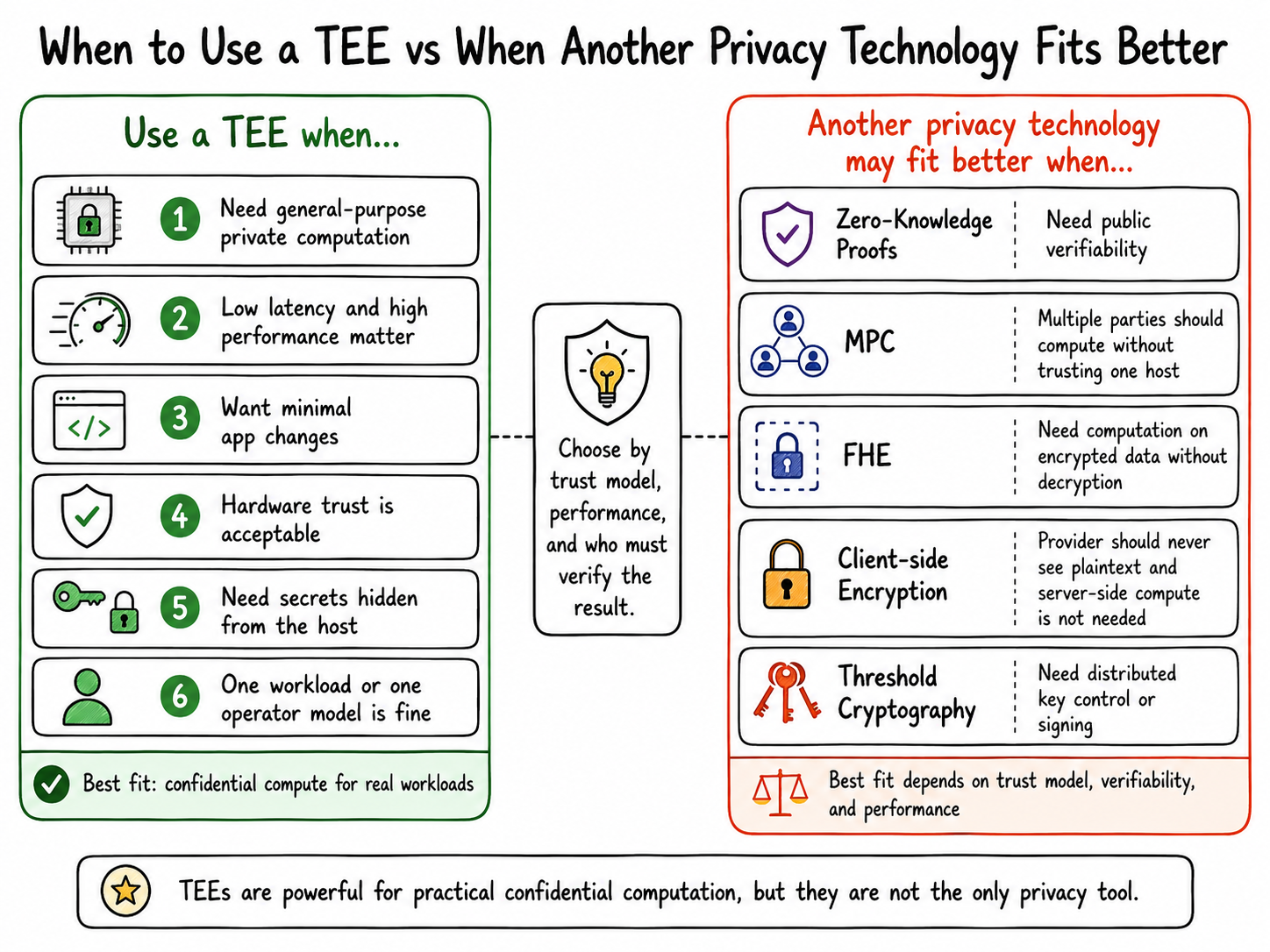
When a TEE may be suitable
A TEE may be useful when:
- Data must be processed in plaintext at some point.
- The host or cloud operator should not read that plaintext.
- General-purpose computation is required.
- Low latency is important.
- The workload is difficult to express as a cryptographic circuit.
- Remote parties need evidence about the loaded software.
- Existing applications must run with limited changes.
- Hardware trust is acceptable for the threat model.
When another approach may be better
A TEE may not be the best primary tool when:
- Public mathematical verification is required.
- Hardware-vendor trust is unacceptable.
- The computation can be expressed efficiently using zero-knowledge proofs.
- Several parties can use secure multi-party computation.
- Data can remain encrypted using homomorphic encryption.
- The main problem is anonymity rather than computation confidentiality.
- Physical attackers are central to the threat model.
- Availability is the main security goal.
- The application cannot safely manage attestation and updates.
A simple decision checklist
Before choosing a TEE, ask:
1. What asset needs protection? 2. Protection from whom? 3. Is the operating system considered malicious? 4. Is the hypervisor considered malicious? 5. Is the cloud provider trusted? 6. Is the hardware vendor trusted? 7. Is physical access part of the threat model? 8. Does the application need public verifiability? 9. Can the computation use ZK, MPC, or FHE instead? 10. What metadata can remain visible? 11. Who verifies the attestation? 12. Who controls the accepted measurements? 13. How will keys be released? 14. How will state rollback be prevented? 15. What happens during an update? 16. What happens if the hardware fails? 17. What happens if the attestation service is unavailable? 18. Can the operator censor requests? 19. Can users verify the software build? 20. What is the recovery plan?
Key takeaways
- TEEs have useful Web2 and Web3 applications.
- A TEE protects a specific execution boundary, not the entire system.
- Attestation does not prove application correctness.
- Output, metadata, endpoints, and availability remain important.
- Hardware and vendor infrastructure remain part of the trust model.
- The decision to use a TEE should follow a written threat model.
Answer the quiz correctly to continue →
Which situation is the strongest fit for using a TEE?