Privacy, Confidentiality, Integrity, and Trust
Security words describe different properties
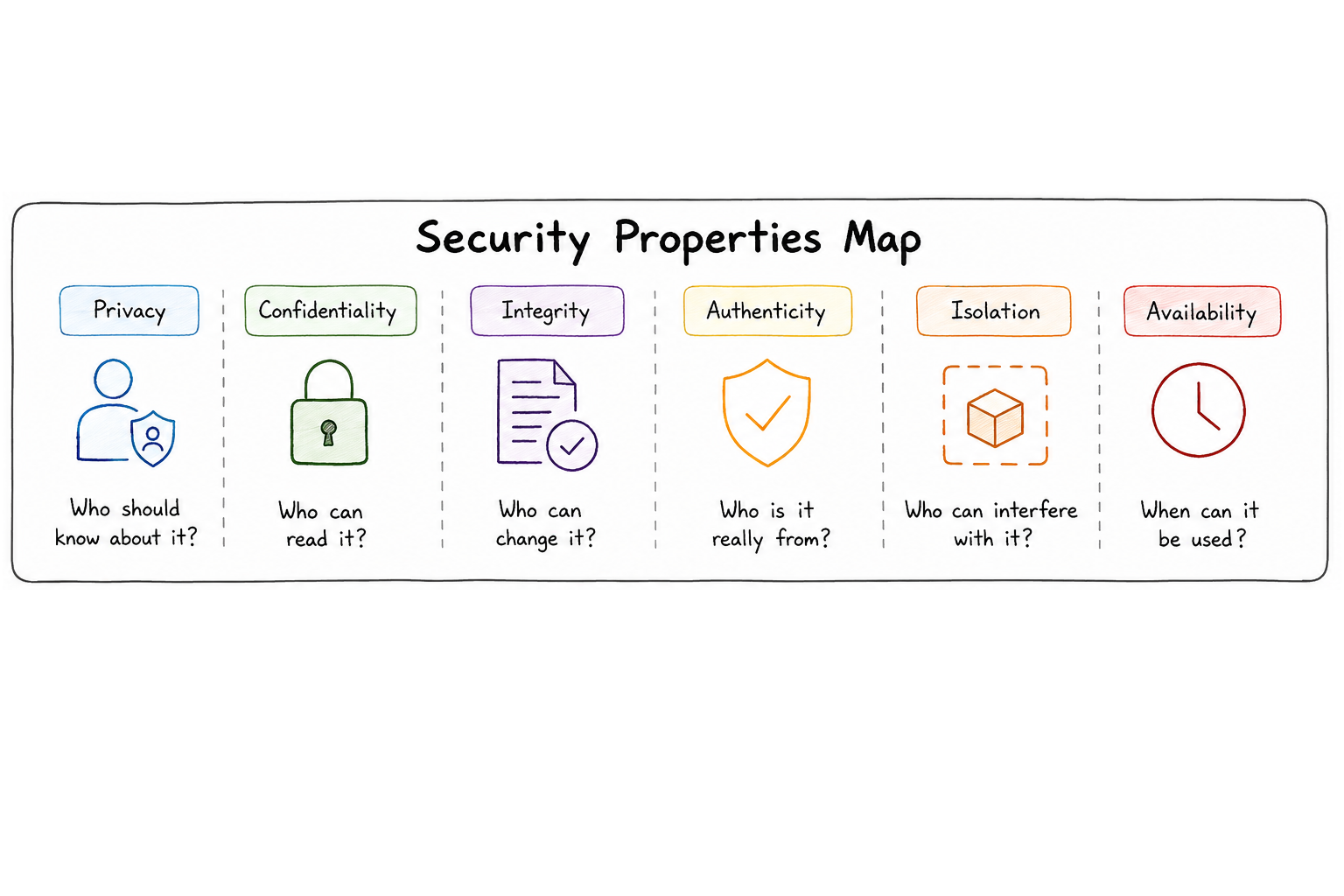
Terms such as privacy, confidentiality, integrity, isolation, authenticity, and availability are often used as if they mean the same thing. They do not.
A secure TEE system must clearly state which property it is trying to provide.
Confidentiality
Confidentiality means preventing unauthorized disclosure of information.
NIST describes confidentiality as protecting sensitive information from unauthorized entities and preserving restrictions on access and disclosure.
In a TEE system, confidentiality may apply to:
- User data
- Private keys
- Application code
- Business logic
- AI model weights
- Transaction strategies
- Authentication material
- Intermediate computation results
Confidentiality asks: Can an unauthorized party read this information?
Integrity
Integrity means protecting information and systems against unauthorized modification or destruction.
It asks: Can an unauthorized party change this information or computation?
Suppose an attacker cannot read a private payment instruction but can change the payment address. The payment remains confidential, but the system has lost integrity.
A useful TEE must normally protect both the confidentiality of code and data, and the integrity of code and data.
Authenticity
Authenticity concerns whether an identity, message, device, or piece of evidence is genuine.
Examples include:
- Did this message come from the expected sender?
- Did this attestation report come from genuine hardware?
- Was this software signed by the approved developer?
- Does this public key belong to the claimed TEE?
Digital signatures and certificate chains are commonly used to support authenticity.
Isolation
Isolation separates one execution context from another.
For example:
- One process from another process
- One virtual machine from another virtual machine
- A secure world from a normal world
- An enclave from its host application
Isolation is a mechanism. Confidentiality and integrity are security properties that the mechanism may help provide.
An isolated environment can still run unsafe or malicious code.
Availability
Availability means that a system or service can be accessed when required. Most TEEs do not fully protect availability.
A malicious host may be unable to read enclave memory but may still:
- Stop the enclave
- Refuse to schedule it
- Block its network access
- Delete its encrypted storage
- Restart it repeatedly
- Delay its responses
- Deny it access to external services
This is why a TEE should not be described as protection against every infrastructure threat.
Privacy
Privacy is broader than confidentiality.
NIST material describes privacy in terms that include control over information, protection from unwanted intrusion, and safeguards for human autonomy and dignity.
Privacy asks questions such as:
- Why is the data being collected?
- Is all the data necessary?
- Can the data be connected to a person?
- Can separate actions be linked?
- How long is the data retained?
- What does the output reveal?
- Who can request a computation?
- Does the user understand the data flow?
- Can logs expose behaviour?
- Can network metadata reveal identity?
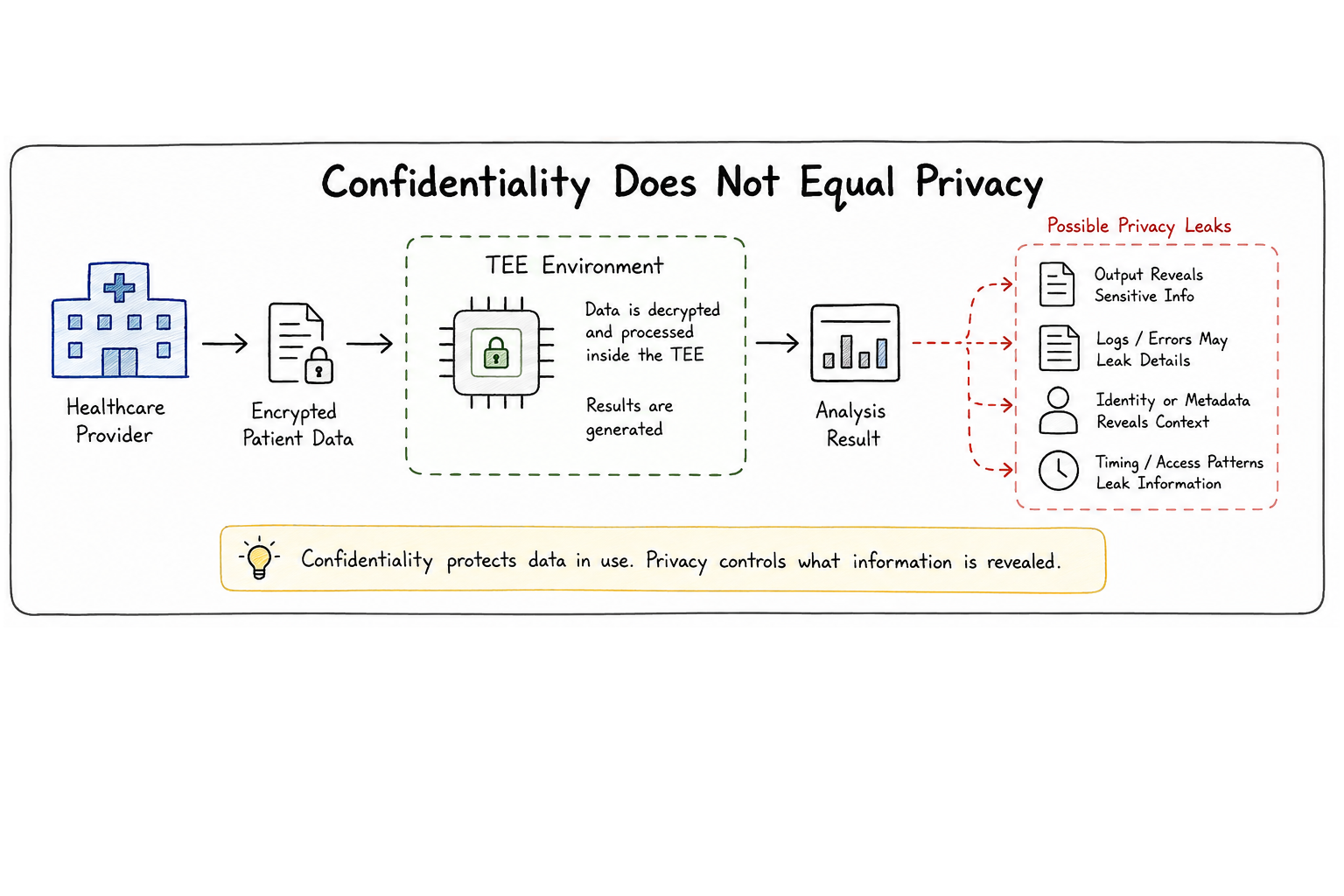
A system can protect confidentiality while still creating privacy risks.
Example: Confidential medical analysis
A hospital processes patient records inside a TEE. The cloud administrator cannot directly read the records during computation.
The program outputs a table showing disease, postal code, age, and number of patients. A rare disease appears in a postal code with only one patient.
The raw computation was confidential. The output may still reveal the patient's identity.
The TEE protected the computation boundary. It did not decide whether the output was safe.
Anonymity and unlinkability
Anonymity means that a person's identity cannot be determined within a relevant group or context.
Unlinkability means that two actions or pieces of data cannot easily be connected to the same person or entity.
A TEE does not automatically provide either property.
A wallet may protect its private signing key inside a TEE while publishing wallet address, transaction amount, timestamp, asset, recipient, and contract interaction. The key remains confidential. The transaction graph remains public and linkable.
Trust is a dependency
In everyday conversation, trust sounds like confidence. In system security, trust is better understood as dependency.
A system trusts a component when its security depends on that component behaving correctly.
A TEE application may trust:
- Processor hardware
- Processor microcode
- Firmware
- TEE runtime
- Application code
- Cryptographic libraries
- Attestation services
- Certificate authorities
- Key management services
The word trusted does not mean that the component is guaranteed to be secure. It means that failure of the component may break the system's security guarantee.
Key takeaways
- Confidentiality protects against unauthorized reading.
- Integrity protects against unauthorized modification.
- Authenticity supports claims about identity and origin.
- Isolation separates execution contexts.
- Availability concerns continued access to a service.
- Privacy includes wider questions about collection, identity, use, outputs, and linkability.
- A trusted component is a security dependency, not a perfect component.
Answer the quiz correctly to continue →
Which example best shows that confidentiality does not automatically guarantee privacy?