Write Side-Channel-Aware Code
What you will learn
This lesson covers:
- Timing leakage
- Cache leakage
- Page-fault leakage
- Branch leakage
- Input and output metadata
- Constant-time programming
- Data-oblivious execution
- Padding and batching
Direct memory protection is not enough
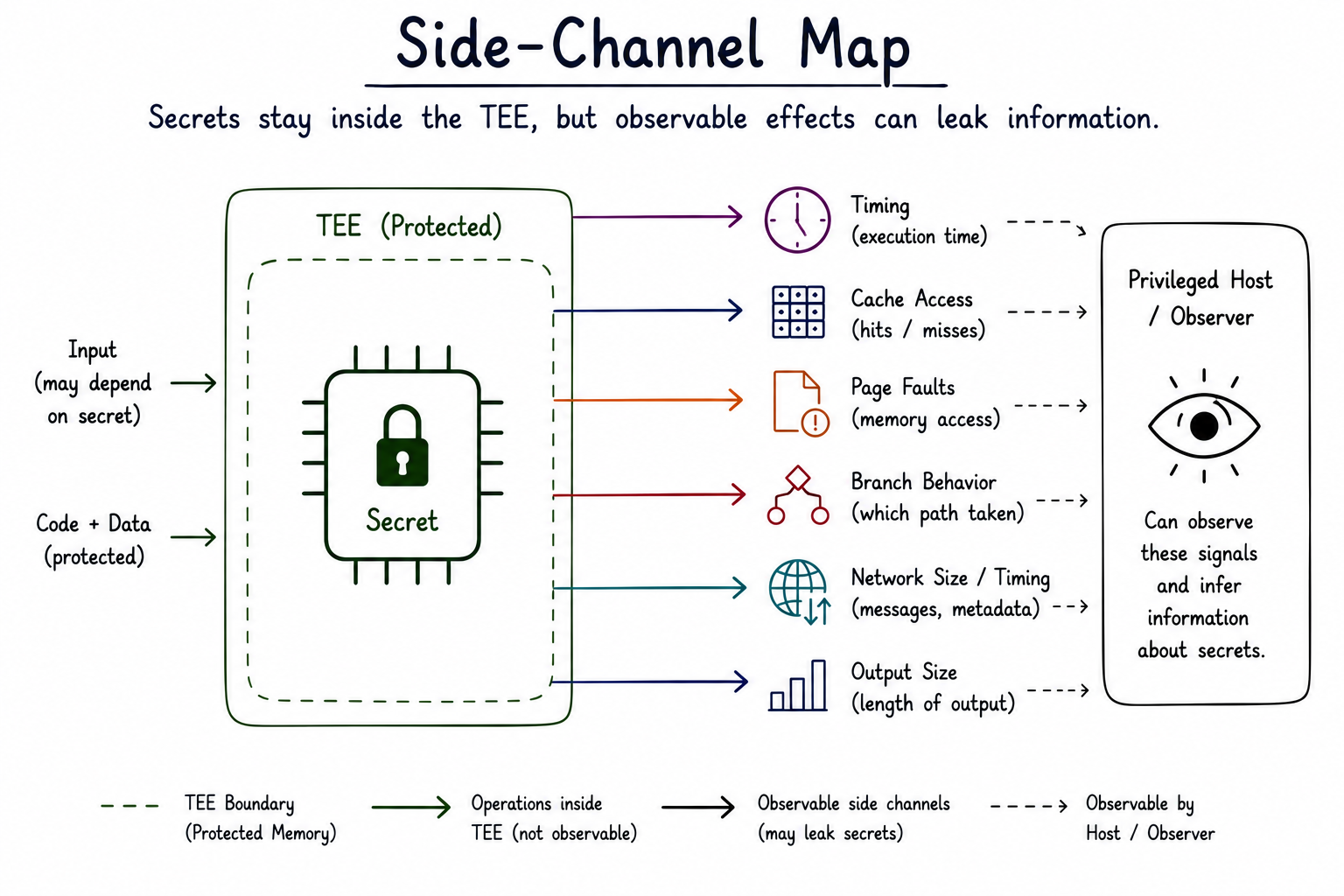
A TEE may stop an attacker from directly reading protected memory.
The attacker may still observe effects produced by the computation.
These effects are called side channels.
Examples include:
- Execution time
- Memory-access pattern
- Cache use
- Page faults
- Branch behaviour
- Interrupt frequency
- Request size
- Response size
- Power use
- Network timing
The protected secret remains inside the TEE, but information about it escapes indirectly.
Timing leakage
Consider:
`` function check_password(input, secret): for i in range(length(secret)): if input[i] != secret[i]: return false return true ``
The function stops at the first mismatch.
An attacker who measures execution time may learn how many initial characters match.
A safer comparison performs a fixed pattern of work:
``` difference = 0
for i in range(FIXED_LENGTH): difference |= input[i] XOR secret[i]
return difference == 0 ```
Secret-dependent branches
A branch such as:
`` if secret_bit == 1: perform_operation_A() else: perform_operation_B() ``
may leak through:
- Timing
- Branch predictor
- Cache
- Instruction fetch
- Page access
Replace secret-dependent control flow where practical with constant-time selection.
Secret-dependent memory access
This lookup may leak:
`` value = table[secret_index] ``
The attacker may infer which cache line or page was accessed.
Possible mitigations include:
- Constant-time lookup
- Scanning full table
- Oblivious data structure
- Bit-sliced implementation
- ORAM-style access
- Batching and shuffling
These mitigations may add large costs.
Controlled-channel attacks
A malicious operating system may manipulate page permissions and observe page faults to learn an enclave's page-level access pattern.
Research on SGX has shown that a privileged host can use page-table and interrupt control to learn detailed execution behaviour without directly reading enclave memory.
More recent work continues to show that controlled-channel and fine-grained interrupt techniques remain relevant to enclave analysis.
Cache attacks
Cores and processes may share caches.
An attacker can measure cache behaviour to infer:
- Which code ran
- Which table entry was used
- Which key-dependent operation occurred
- Which model layer or data path was active
Practical research has demonstrated cache attacks against SGX workloads, including cryptographic and genomic-processing examples.
Page-level versus cache-level leakage
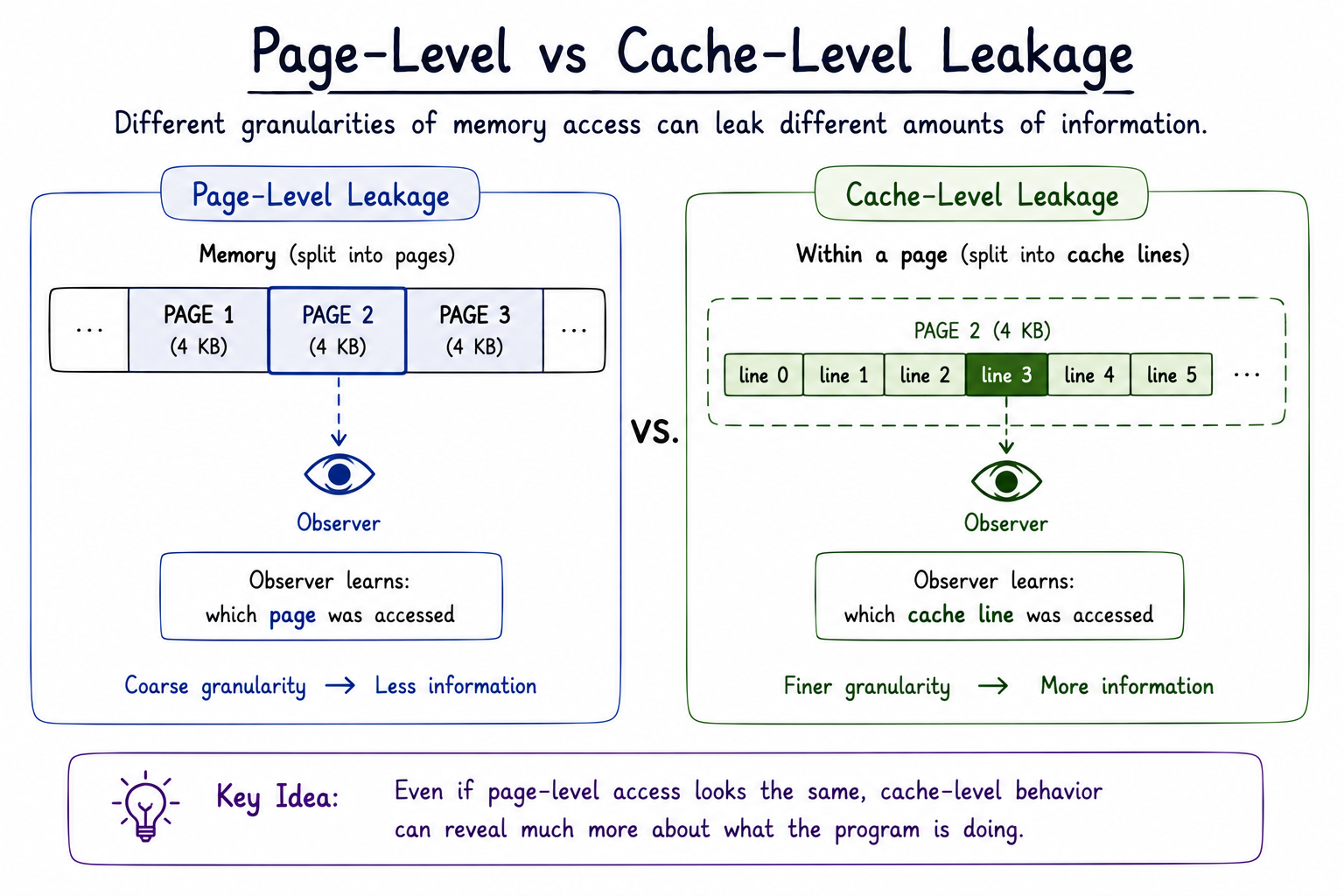
Page-level
- Coarser granularity
- May reveal which 4 KB region was accessed
- Host can induce and observe faults
Cache-level
- Finer granularity
- May reveal cache-line access
- Often more difficult to measure
- Shared hardware can amplify leakage
A defense against one channel may not defend against the other.
Network metadata
A perfectly constant-time enclave can still leak through its network behaviour.
Observers may learn:
- When a user connects
- Request size
- Response size
- Number of requests
- Time between requests
- Processing duration
- Retry behaviour
Mitigations include:
- Fixed-size messages
- Padding
- Batching
- Delayed responses
- Cover traffic
- Request mixing
These protections add bandwidth and latency.
Output leakage
The application output may reveal more than the side channels.
Example:
A private medical query returns exact results for a group of one person.
The TEE correctly protected the input during execution.
The output reveals the person's condition.
Side-channel-safe execution does not replace:
- Data minimization
- Query restriction
- Differential privacy
- Minimum group size
- Output filtering
Data-oblivious programming
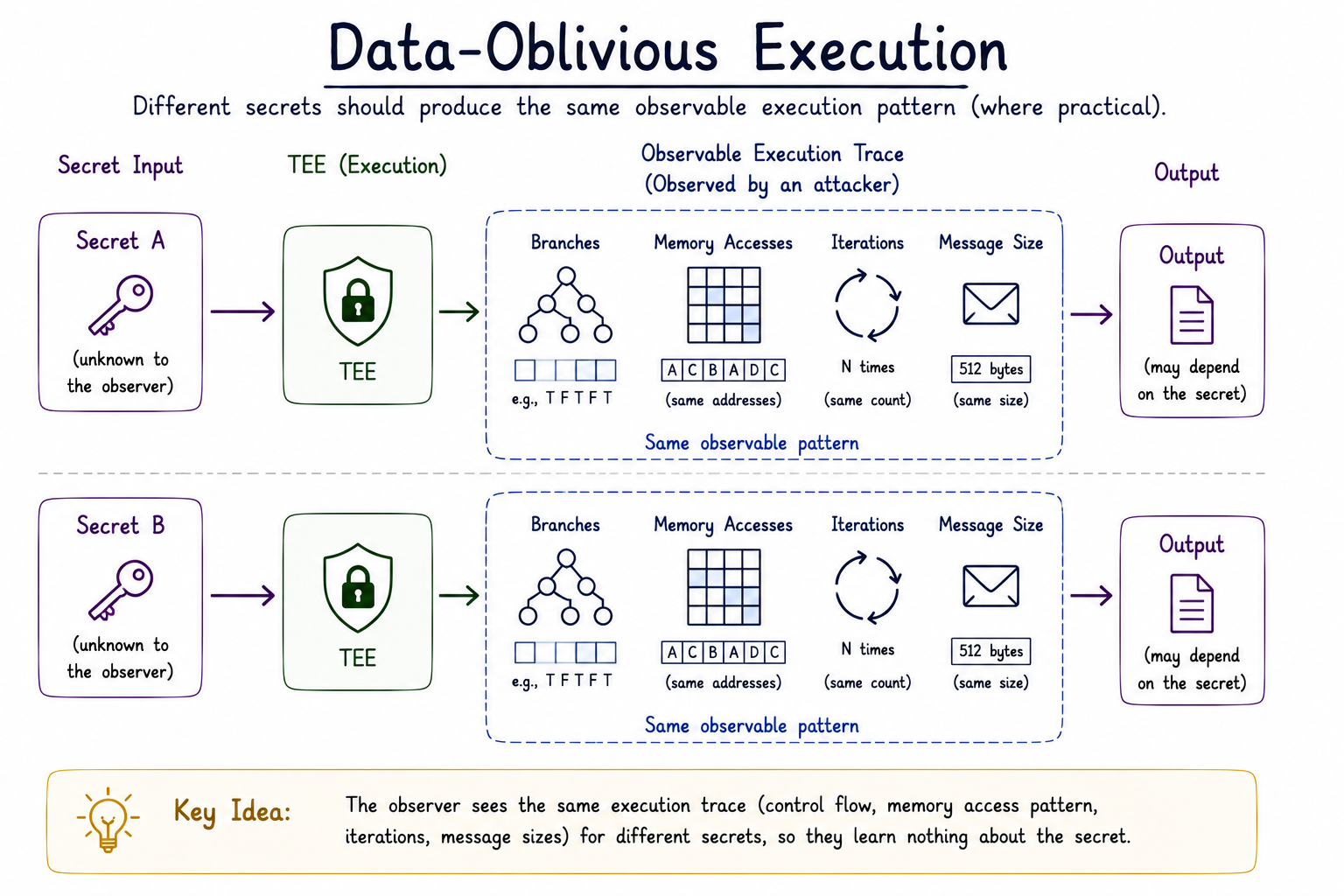
A data-oblivious program aims to keep observable execution behaviour independent of secret values.
This may require:
- Fixed iteration count
- Fixed memory-access pattern
- No secret-dependent branch
- Fixed-size messages
- Fixed output timing
- Fixed resource allocation
Complete obliviousness can be expensive or impossible for a large general-purpose application.
Developers should identify the most sensitive operations and decide which leakage is acceptable.
Side-channel review questions
For every sensitive function, ask:
1. Does execution time depend on the secret? 2. Does control flow depend on the secret? 3. Does memory location depend on the secret? 4. Does output length depend on the secret? 5. Does the number of host calls depend on the secret? 6. Does error type depend on the secret? 7. Does storage access depend on the secret? 8. Does model execution path depend on the input? 9. Can the host interrupt at chosen points? 10. Can repeated queries amplify leakage?
Example: Private inference
A model may keep prompts and weights inside a confidential CPU and GPU environment.
The observer may still learn:
- Prompt length
- Number of generated tokens
- Generation speed
- Model size
- Batching pattern
- Whether a safety path was triggered
Possible mitigations include:
- Input padding
- Output buckets
- Fixed generation limits
- Request batching
- Restricted telemetry
Side-channel testing
Testing methods may include:
- Timing distributions
- Cache-performance analysis
- Page-fault traces
- Differential input testing
- Repeated-query analysis
- Static analysis for secret-dependent branches
- Dynamic instrumentation
- Manual cryptographic code review
A successful test does not prove the absence of every side channel.
It provides evidence about tested channels and conditions.
Developer exercise
Review this operation:
`` function lookup_user(secret_user_id): record = database[secret_user_id] if record.is_vip: run_extended_analysis(record) return record.score ``
List leakage through:
- Memory access
- Branches
- Timing
- Output
- Storage
- Network
Rewrite the design to reduce two of those channels.
Common mistakes
Key takeaways
- Side channels reveal indirect information.
- Secret-dependent branches and memory access are common causes.
- Page-fault and cache channels can be controlled by privileged attackers.
- Network and output metadata remain outside processor protections.
- Mitigations have performance and usability costs.
- Document which channels were tested and which remain.
Check your understanding
1. How can a page-fault trace reveal a secret? 2. Why can constant-time code still leak through output size? 3. What is a secret-dependent memory access? 4. Why are repeated queries dangerous? 5. What does data-oblivious execution attempt to hide?
Answer the quiz correctly to continue →
A TEE application uses fully constant-time cryptographic operations and outputs encrypted data. An attacker monitoring network traffic observes that responses to longer inputs take longer and are larger. Which side channel remains?