Study Real Web2 and Web3 Architectures
What you will learn
This lesson studies how TEE components are arranged in:
- Confidential AI
- Data clean rooms
- Secure credential processing
- Private order flow
- Off-chain coprocessing
- On-chain attestation
- Decentralized TEE networks
Case study method
For every TEE system, ask:
1. What runs inside the TEE? 2. What remains outside? 3. Who operates the hardware? 4. Who controls the reference measurement? 5. Who verifies attestation? 6. How are keys released? 7. How is state stored? 8. How are updates handled? 9. What metadata remains visible? 10. What happens if the operator stops responding? 11. What happens if the hardware vendor is compromised? 12. Is a TEE necessary?
Web2 pattern 1: Confidential AI inference
Problem
A company wants to use an AI model without revealing:
- User prompts to the infrastructure operator
- Model weights to the customer
- Private enterprise documents to the model provider
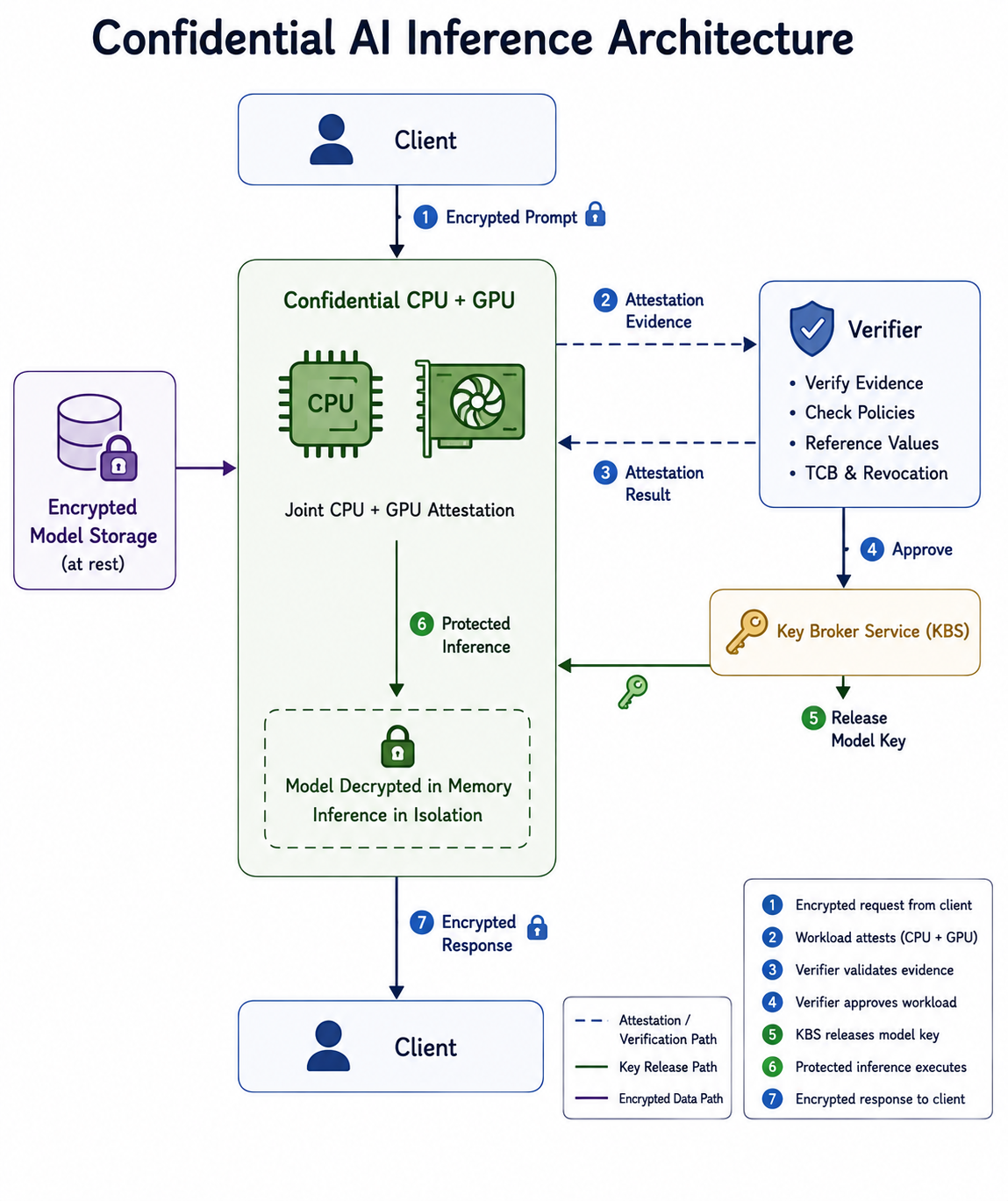
Architecture
Possible components:
- User client
- Attestation verifier
- Confidential VM
- Confidential GPU
- Model server
- KBS
- Encrypted model storage
- Privacy-safe logging
Flow
1. Workload starts. 2. CPU and GPU evidence is collected. 3. Verifier checks expected software and device state. 4. KBS releases model and data keys. 5. Client establishes an attested channel. 6. Prompt and model are decrypted in protected memory. 7. Inference runs. 8. Output is encrypted to the client.
Remaining risks
- Prompt length
- Output length
- Token timing
- Model vulnerabilities
- Unsafe output
- Client compromise
- Availability
- Device-side leakage
Web2 pattern 2: Data clean room
Problem
Several organizations want to calculate a result over combined datasets without sharing raw records.
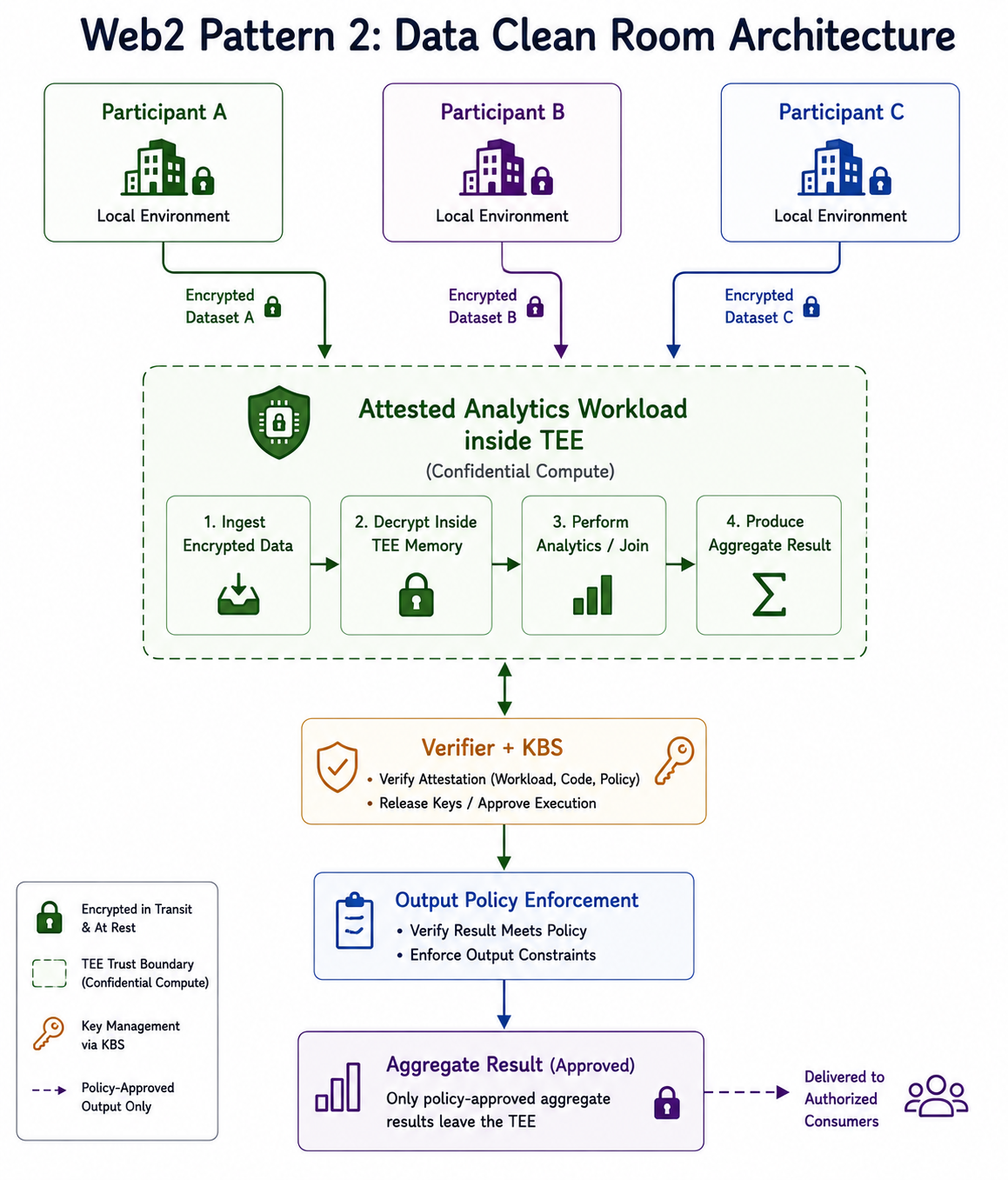
Architecture
- Participant A
- Participant B
- Participant C
- Verifier
- Approved analytics workload
- KBS
- Confidential VM or enclave
- Output policy
Flow
1. Participants agree on the source code or measurement. 2. Each participant verifies the workload. 3. Each participant encrypts data to the attested key. 4. Workload combines datasets. 5. Workload applies output policy. 6. Aggregate result is returned.
Remaining risks
- Malicious participant input
- Small-group output leakage
- Repeated queries
- Query differencing
- Operator censorship
- Side channels
- Unsafe analytics code
Web2 pattern 3: Secure credential service
A TEE or isolated enclave may protect:
- Token signing
- Password verification
- API-key processing
- Certificate issuance
- Payment tokenization
The design should expose policy-controlled operations rather than raw keys.
A credential TEE should track:
- Who requested the operation
- What policy allowed it
- Whether the request is fresh
- Whether the state can be rolled back
- Whether duplicate instances can sign
Web3 pattern 1: Private order flow
Problem
Public transaction intent can allow:
- Front-running
- Sandwich attacks
- Copy trading
- Strategy extraction
- Adverse transaction ordering
TEE architecture
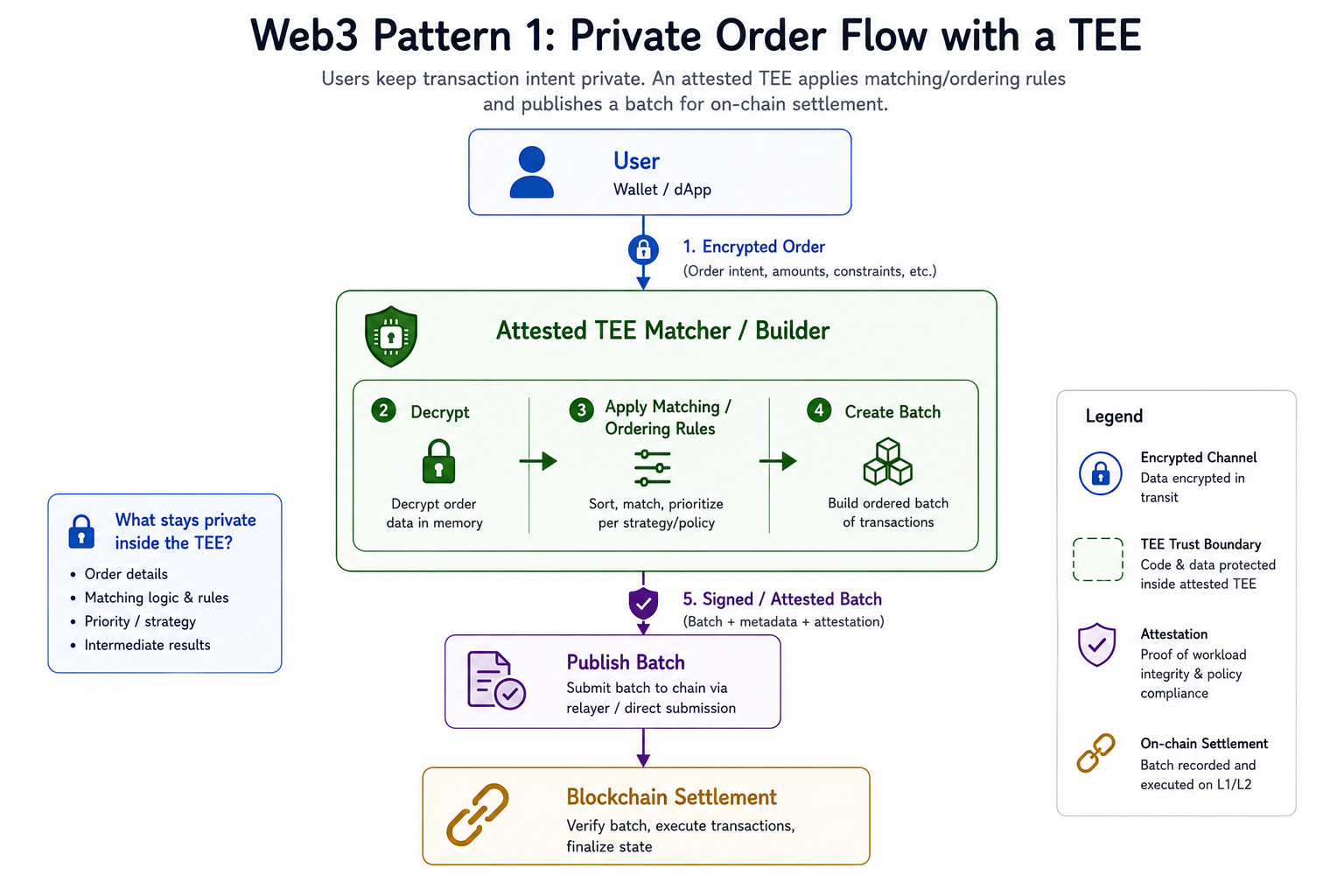
Users encrypt orders to an attested block-building or matching workload.
The TEE:
1. Decrypts private intent. 2. Applies an ordering or matching rule. 3. Creates an output batch. 4. Signs or attests to the result. 5. Publishes settlement data.
Remaining risks
- Operator censorship
- Selective inclusion
- Incorrect ordering code
- Rollback
- Side-channel leakage
- Attestation centralization
- Public settlement metadata
- Availability
Flashbots currently describes BuilderNet as a block-building network running on TEEs, and Rollup-Boost as using TEE information-security properties for verifiable priority ordering.
The architecture should be evaluated through its actual code, measurement, operator set, and verification flow rather than through a general "TEE-powered" label.
Web3 pattern 2: Off-chain coprocessor
Problem
A smart contract needs computation that is:
- Too expensive on-chain
- Private
- Stateful
- Dependent on external data
- Difficult to express as a ZK circuit
Flow
1. Contract emits a request. 2. TEE worker receives input. 3. Worker verifies on-chain state. 4. TEE performs computation. 5. TEE signs output. 6. Contract verifies approved TEE identity. 7. Contract applies result.
Main questions
- How does the TEE read canonical chain state?
- Can the host provide a fake chain view?
- Can the operator withhold results?
- Can two workers return conflicting outputs?
- How is attestation verified on-chain?
- How are revoked machines removed?
- Is output correctness independently checked?
Web3 pattern 3: Decentralized TEE cloud
A decentralized TEE network may allow independent operators to run confidential workloads.
Phala's current documentation describes confidential applications and off-chain computation deployed through TEE-based cloud infrastructure, including confidential virtual-machine deployment and attestation inspection.
Marlin Oyster documentation provides tooling to verify AWS Nitro attestation, expected measurements, root keys, user data, and evidence freshness. It warns that production verification should include expected measurements rather than checking only the document structure and certificate chain.
The important lesson is that decentralizing operators does not automatically decentralize:
- Hardware roots
- Attestation roots
- Measurement policy
- Software releases
- Key release
- Governance
Web3 pattern 4: On-chain attestation verification
Smart contracts may verify or consume evidence about a TEE.
Automata currently documents verifier contracts for Intel SGX, Intel TDX, AMD SEV-SNP, and AWS Nitro attestation families.
On-chain verification can improve:
- Auditability
- Reuse of verified machine identity
- Smart contract integration
- Public policy enforcement
It also introduces:
- Gas or proving cost
- Complex certificate parsing
- Collateral updates
- Revocation management
- Contract upgrade risk
- Dependence on vendor roots
Oracle warning
A TEE-backed oracle can prove which oracle program processed data.
It does not prove that:
- The external source was truthful.
- The HTTPS endpoint was honest.
- The host did not block one source.
- The application chose the correct source.
- The economic result is safe.
The data origin remains part of the trust model.
Case-study worksheet
For each real system, fill in:
`` Protected asset: TEE platform: Trusted code: Untrusted code: Operator: Attestation verifier: Reference-value owner: Secret provider: Persistent state: Rollback control: User verification: Output verification: Availability dependency: Main metadata leakage: Fallback: ``
Developer exercise
Choose one system:
- Confidential AI
- Private order flow
- TEE oracle
- Data clean room
- Decentralized TEE cloud
Create:
1. Architecture diagram 2. Trust boundary 3. Attestation flow 4. Key-release flow 5. State flow 6. Five remaining risks 7. One alternative design without a TEE
Common mistakes
Key takeaways
- Study complete architectures, not product labels.
- Web2 and Web3 systems share the same core TEE problems.
- Attestation proves selected state claims, not full correctness.
- Decentralized operators may still share one hardware root.
- On-chain verification adds transparency but increases operational complexity.
- Every case study should identify remaining leakage and availability dependencies.
Check your understanding
1. What does a TEE-backed oracle fail to prove? 2. Why can a data clean room leak through its outputs? 3. What central trust may remain in a decentralized TEE network? 4. Why should an on-chain verifier track attestation collateral? 5. What risks remain in private order flow after encryption?
Answer the quiz correctly to continue →
A TEE-backed oracle fetches a price feed from an HTTPS endpoint, signs the result, and posts it on-chain using approved software in a correctly attested enclave. What does the attestation evidence fail to prove?