Protect Persistent State and Prevent Rollback
What you will learn
This lesson covers:
- Sealed state
- State versions
- Replay
- Rollback
- Forking
- Monotonic counters
- External state services
- Crash recovery
- Migration
Encryption does not prove freshness
A TEE may encrypt and authenticate data before storing it outside the trusted boundary.
This protects against:
- Unauthorized reading
- Unauthorized modification
- Forged ciphertext
It does not automatically prove that the ciphertext is the newest valid state.
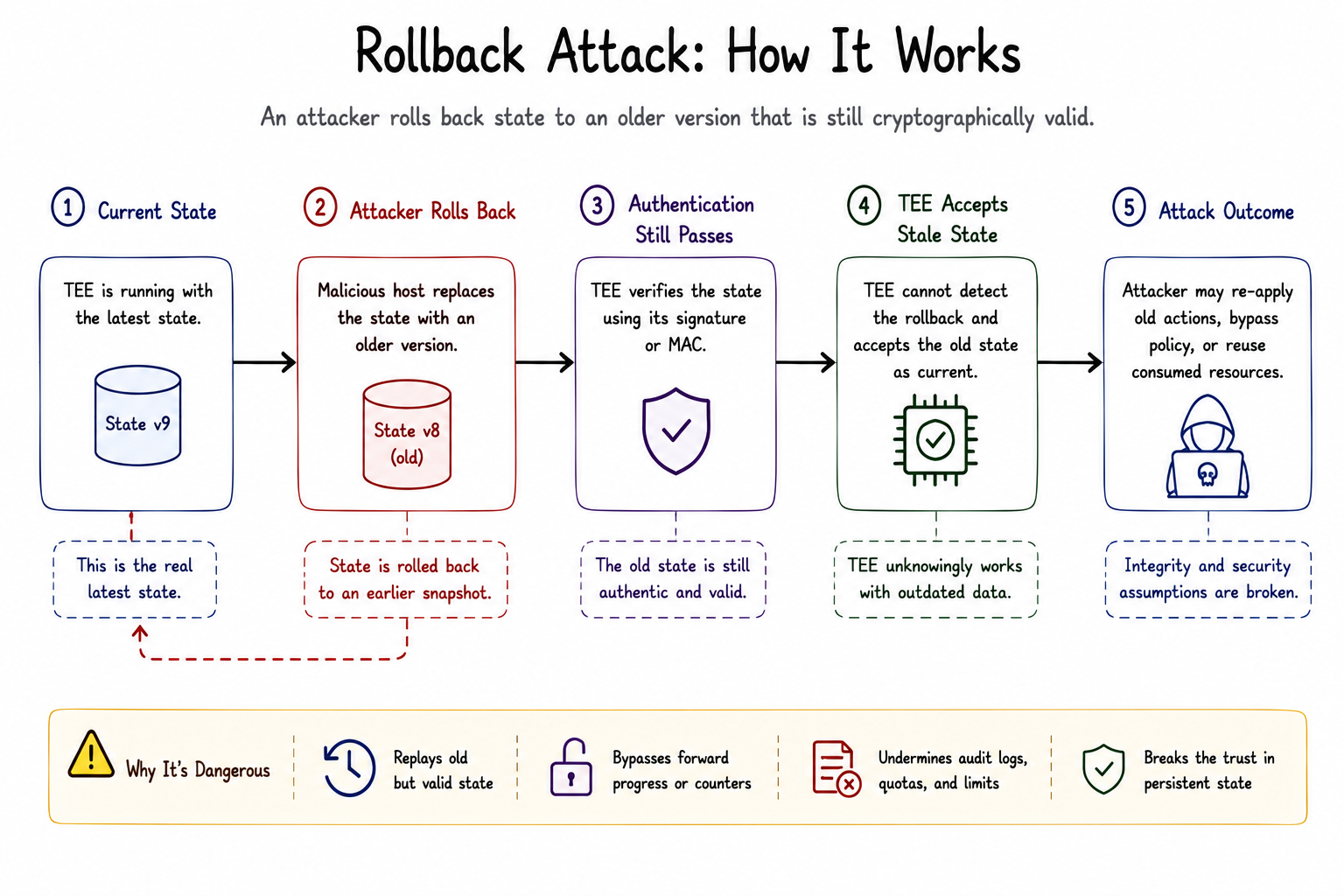
A malicious host can restore an older file that was genuinely created by the application.
Example: Balance rollback
State 8:
`` balance = 100 version = 8 ``
State 9:
`` balance = 20 version = 9 ``
Both states are encrypted and authenticated.
The host replaces state 9 with state 8.
The authentication check passes because state 8 is genuine. The application now operates on stale state.
Replay, rollback, and forking
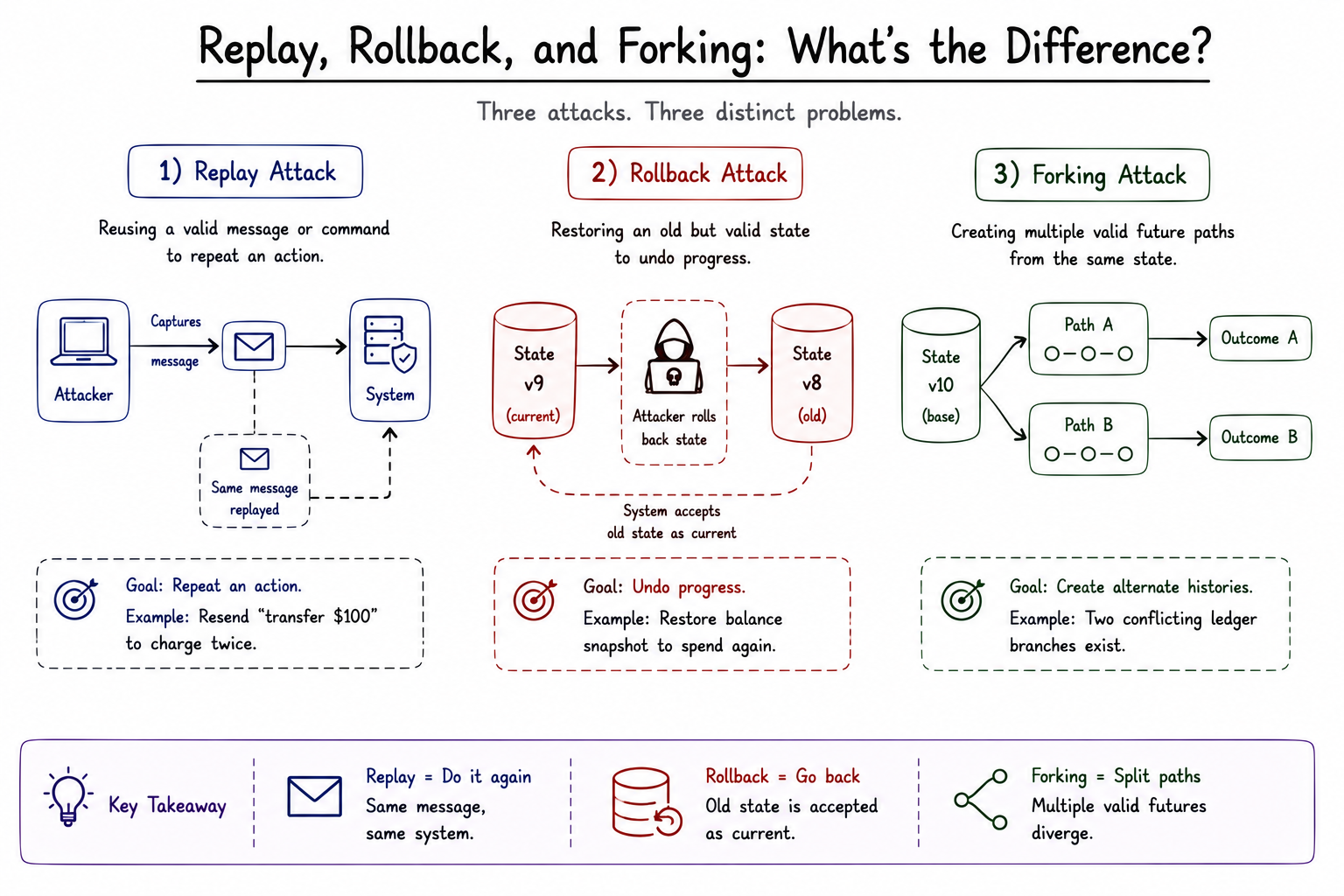
Replay
An old valid message or request is submitted again.
Example:
- Reusing an old withdrawal request
Rollback
The system's state is restored to an older valid version.
Example:
- Replacing a current sealed database with an older snapshot
Forking
Different clients are shown different valid state histories.
Example:
- Client A sees version 10.
- Client B sees a separate version 10 derived from version 9.
- Both histories appear locally valid.
Forking is especially important in distributed and Web3 systems.
State-continuity invariant
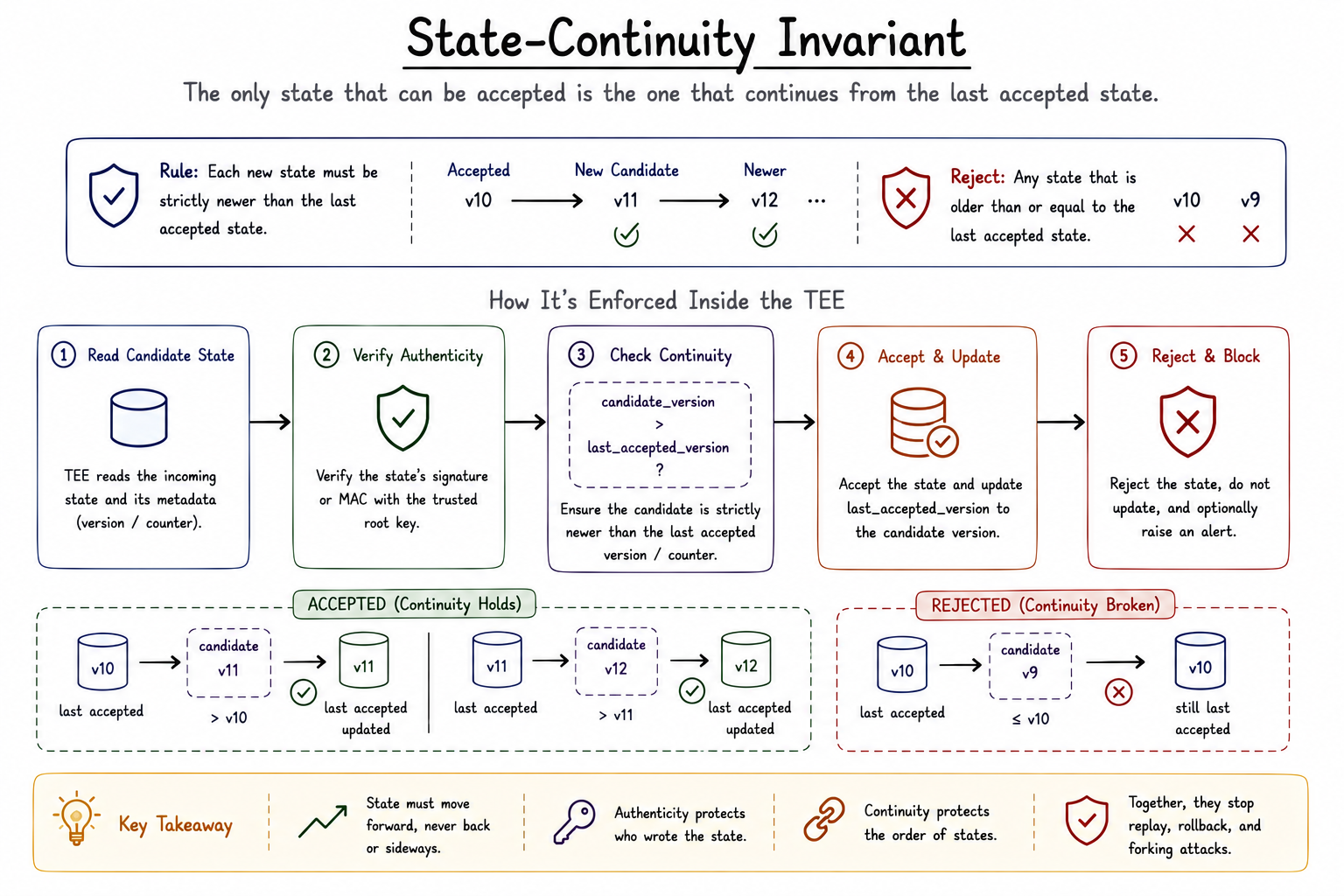
Define a rule that must always hold.
Example:
`` accepted_version > previously_accepted_version ``
Or:
`` new_state.previous_hash == current_state.hash ``
The TEE needs a trusted way to remember or verify the current state.
Hash-chained state
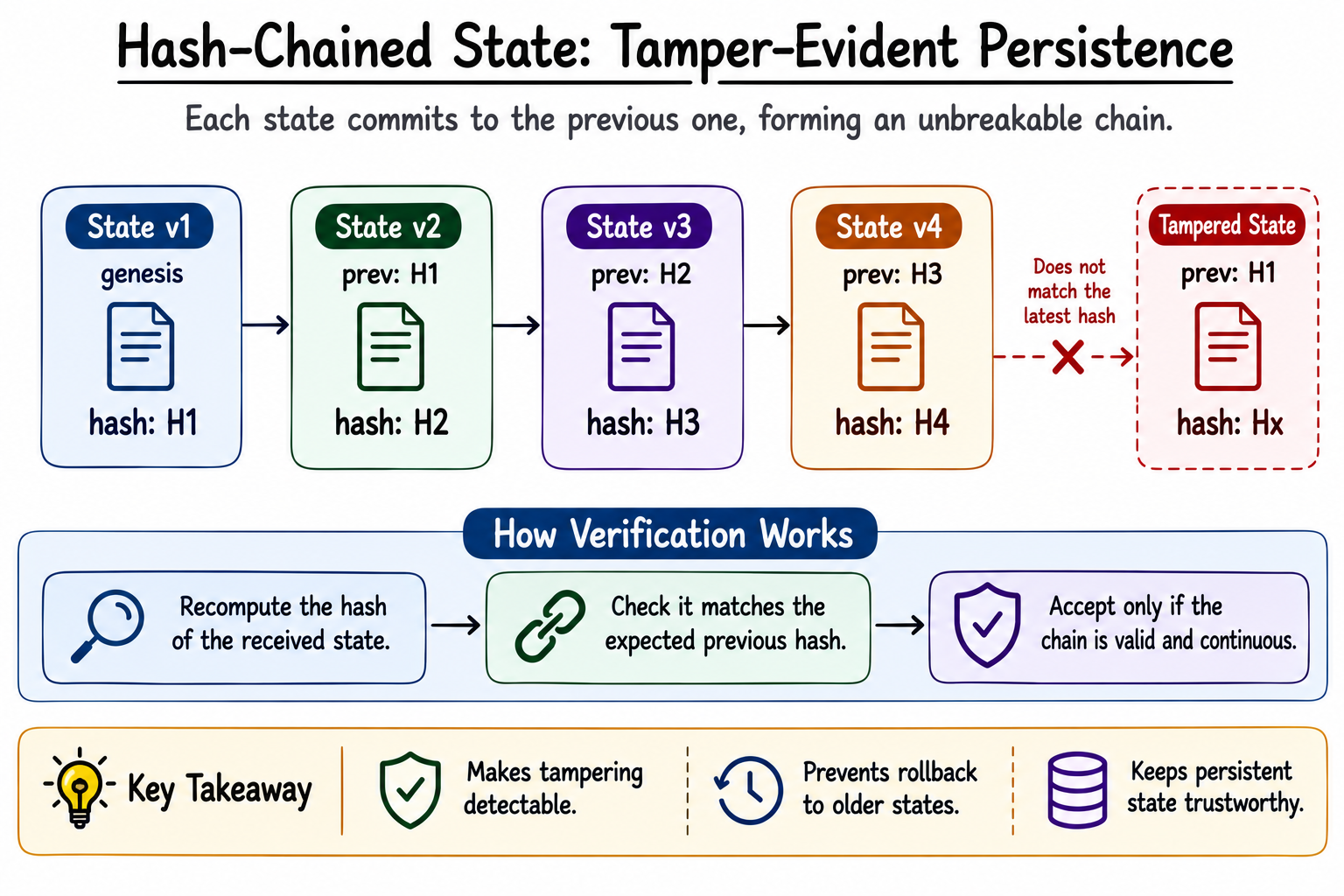
A state record may contain:
`` version state_data previous_state_hash current_state_hash signature ``
The new state commits to the previous state.
This detects modification of the chain.
It does not stop the host from presenting an older valid chain unless the TEE knows which version is current.
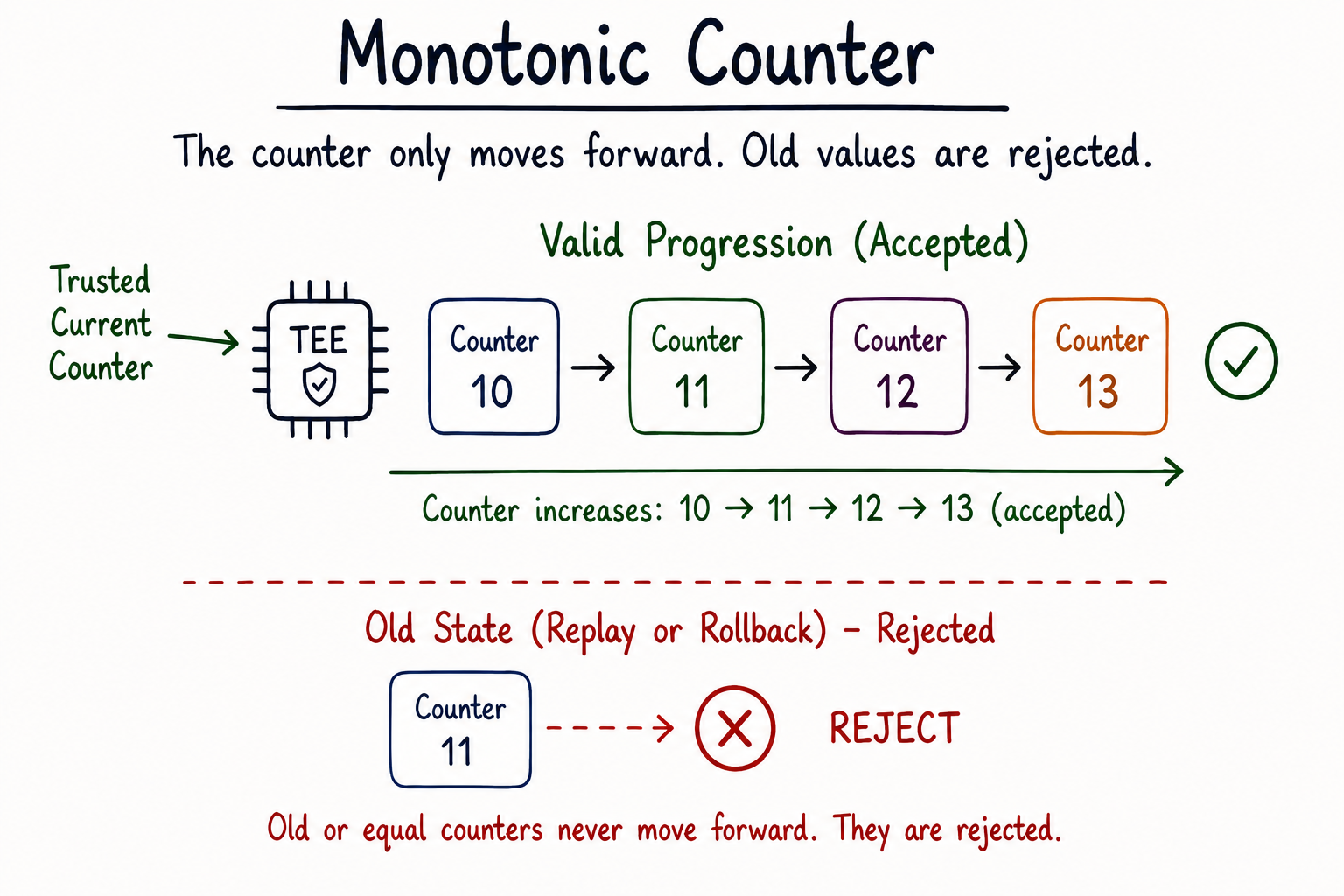
Monotonic counters
A monotonic counter moves only forward.
A stored state can include the expected counter value.
The TEE checks:
`` stored_counter == trusted_counter ``
Then increments the trusted counter when saving new state.
Possible counter sources include:
- Hardware counter
- Secure platform service
- Remote consensus service
- Distributed database
- Blockchain contract
Hardware counters may have limits involving:
- Performance
- Wear
- Availability
- Migration
- Platform dependence
External freshness service
A TEE may store the latest state hash with an external service.
The service may provide:
- Latest version
- Signed checkpoint
- Append-only log
- Quorum confirmation
This creates a new trusted component.
Ask:
- Can the service lie?
- Can it fork clients?
- Can it become unavailable?
- Can the host block access to it?
- Can multiple operators collude?
Blockchain as a state anchor
A public blockchain can record:
- State commitment
- Sequence number
- Enclave identity
- Update transaction
- Recovery authorization
Benefits may include:
- Shared state visibility
- Ordered updates
- Tamper-evident history
- Multiple independent observers
Costs include:
- Public metadata
- Transaction fees
- Confirmation delay
- Smart contract risk
- Chain reorganization assumptions
- Censorship risk
The blockchain does not automatically protect the privacy of the committed metadata.
Atomic state update
The application should avoid partial updates.
A basic flow may be:
1. Read current protected state. 2. Verify authentication. 3. Check version. 4. Perform operation. 5. Create new state. 6. Commit new external checkpoint. 7. Write sealed state. 8. Confirm success. 9. Mark previous state obsolete.
The exact order depends on recovery requirements.
A crash between steps can create inconsistent state.
Write-ahead log
A write-ahead log records intended changes before the main state is updated.
The TEE may:
1. Write signed intent. 2. Confirm durable storage. 3. Apply state change. 4. Write completion record. 5. Update current checkpoint.
The log must also have anti-rollback protection.
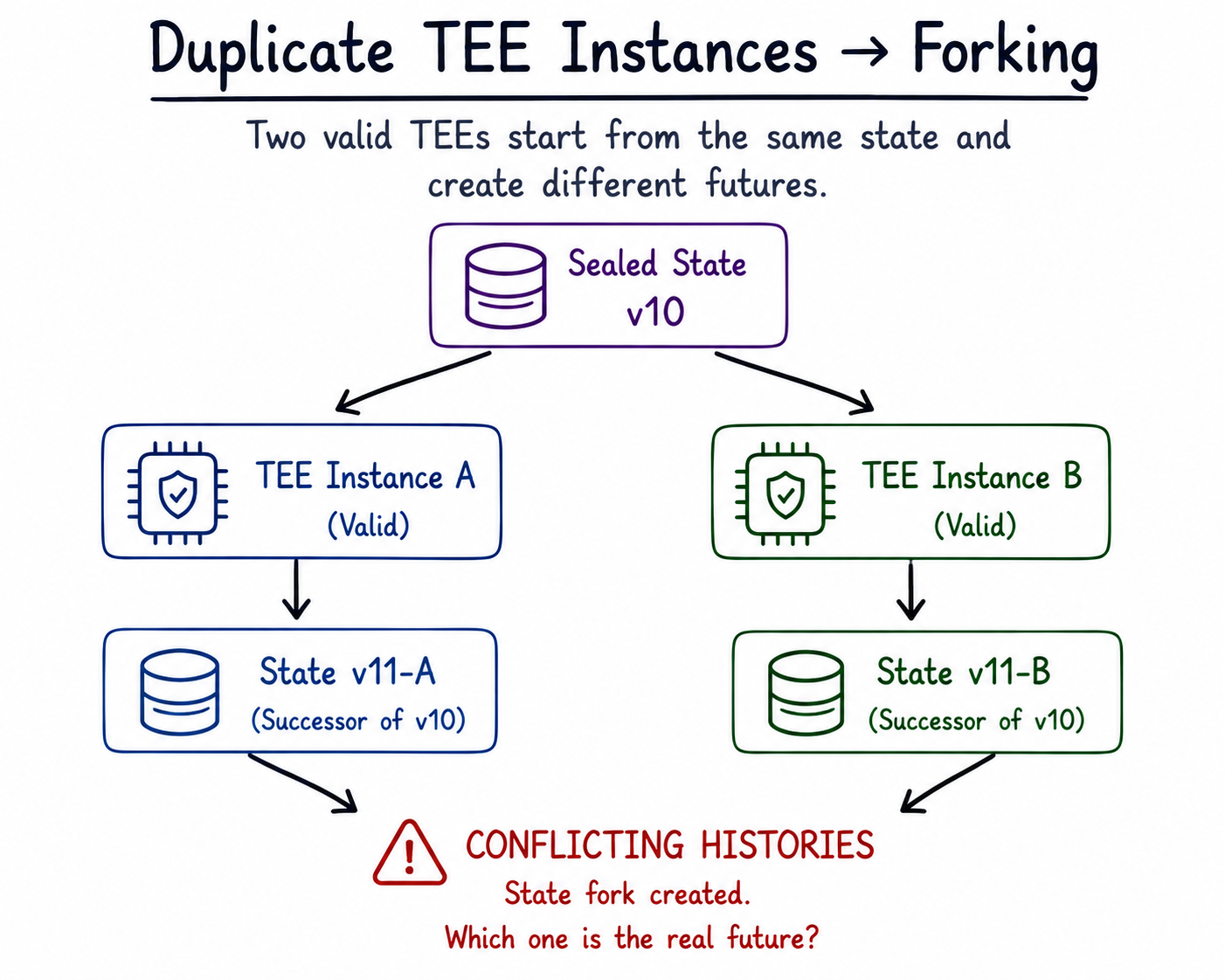
Duplicate TEE instances
Two valid instances may start from the same sealed state.
Both may produce new valid state.
This creates a fork even without breaking encryption.
Possible controls include:
- Lease service
- Leader election
- Distributed lock
- Consensus protocol
- Single-use state token
- Threshold authorization
- On-chain sequence number
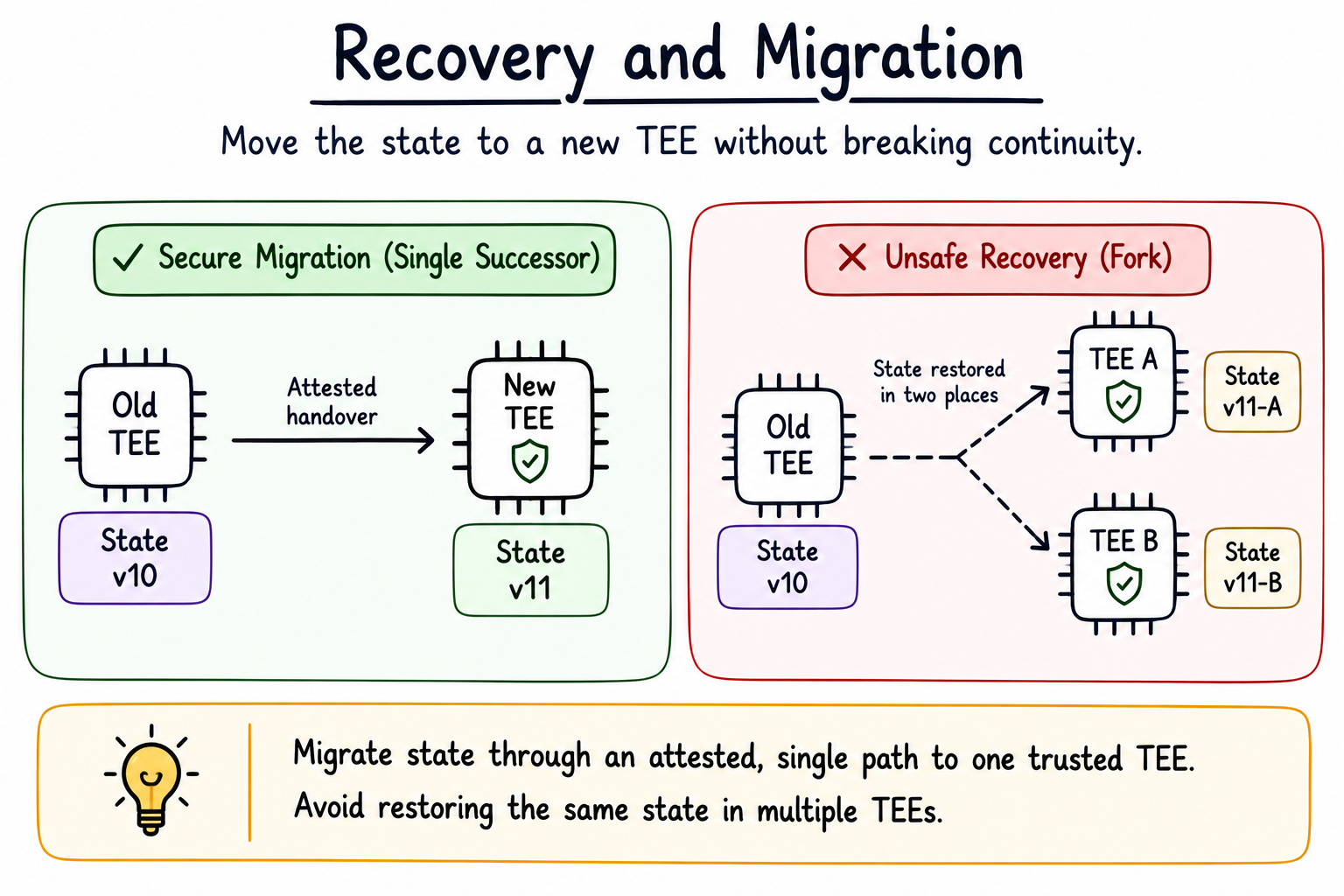
Recovery and migration
Recovery may require moving state to:
- New machine
- New TEE platform
- New software version
- New cloud provider
- New region
A migration protocol may:
1. Attest old workload. 2. Attest new workload. 3. Check migration policy. 4. Establish a protected channel. 5. Transfer state and keys. 6. Record migration checkpoint. 7. Revoke old instance. 8. Confirm that old state cannot continue.
Example: Validator signing state
A validator key is protected inside a TEE.
The TEE tracks the latest signed block height.
The host restores an older signing-state snapshot.
The enclave may now sign a conflicting message for a height it had already signed.
The key was never extracted.
The rollback still caused a security failure.
The correct protected asset is:
- Key bytes
- Signing policy
- Signing history
- Current state version
Developer exercise
Design state continuity for a private auction.
The application must prevent:
- Bid replay
- Deadline rollback
- Duplicate winner selection
- Two enclave instances publishing different winners
Choose one state anchor and explain:
- Trust assumptions
- Failure mode
- Recovery process
- Metadata leakage
- Availability cost
Common mistakes
Key takeaways
- Authentic storage does not prove that state is current.
- Replay, rollback, and forking are different problems.
- State continuity needs a trusted forward-moving reference.
- External counters and blockchains introduce new assumptions.
- Crash recovery and migration must be designed before production.
Check your understanding
1. Why does an authenticated old state still pass verification? 2. What is the difference between rollback and forking? 3. Why is a version stored only inside sealed data insufficient? 4. How can two valid TEE instances create a fork? 5. What new risks appear when a blockchain is used as a state anchor?
Answer the quiz correctly to continue →
A TEE stores its state as an authenticated encrypted blob on untrusted host storage. The authentication tag is valid and decryption succeeds. Why can the host still execute a rollback attack?