Learn From Hardware and Firmware Failures
What you will learn
This lesson covers:
- Microarchitectural attacks
- Speculative execution
- Fault injection
- Firmware compromise
- Microcode risk
- Platform patching
- TCB recovery
- Security advisories
Hardware is trusted, not infallible
A TEE depends on processor hardware and firmware.
That dependency creates strong isolation, but it also creates a serious failure mode.
When hardware assumptions break, many workloads may be affected at once.
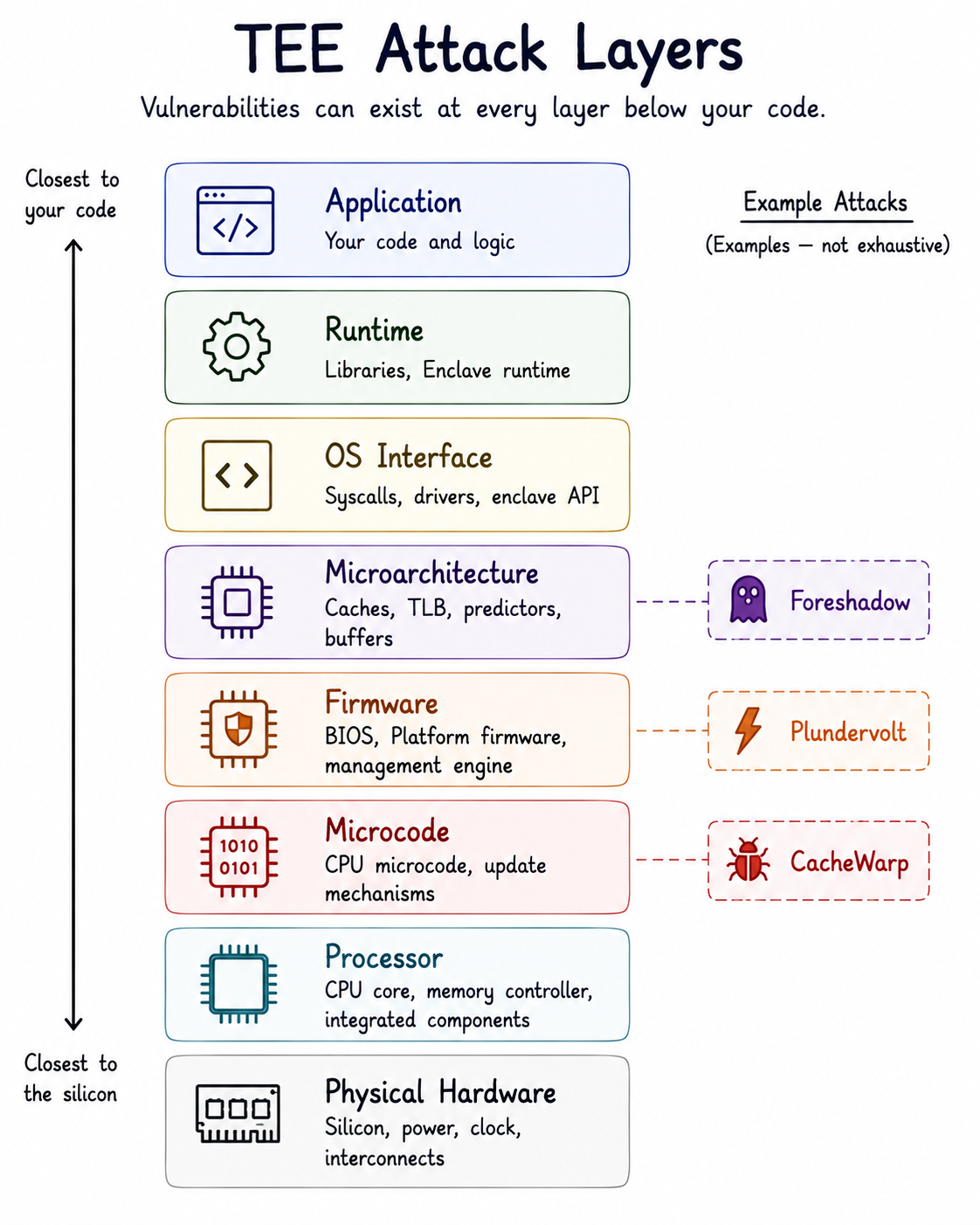
TEE developers need to understand attack classes, not only product features.
Transient and speculative execution attacks
Modern processors execute instructions speculatively to improve performance.
A processor may begin work before it knows whether that work should be committed.
The architectural result may be discarded, while microarchitectural effects remain visible through a side channel.
Foreshadow demonstrated that transient execution could leak SGX enclave secrets and, in the studied systems, undermine attestation-related keys and trust assumptions.
The main lesson is:
> Architectural access control does not automatically control every microarchitectural effect.
Fault injection
Fault injection causes the processor to execute incorrectly.
Possible fault sources include:
- Voltage manipulation
- Clock manipulation
- Power interruption
- Laser or electromagnetic injection
- Cache-state manipulation
- Rowhammer-style effects
- Firmware abuse
- Malicious microcode
Plundervolt showed that privileged software could use voltage-control interfaces to corrupt Intel SGX computations. The attack targeted integrity inside the processor rather than modifying protected external memory.
CacheWarp
CacheWarp demonstrated a software-controlled fault attack against AMD SEV-ES and SEV-SNP.
The attack used cache invalidation behaviour to make a guest continue from stale architectural state. Demonstrations included cryptographic-key recovery, authentication bypass, and privilege escalation.
The lesson is not that memory integrity is useless.
The lesson is that the guarantee depends on the complete interaction between:
- Caches
- Memory
- Instructions
- Hypervisor control
- Firmware
- Microcode
System Management Mode risk
System Management Mode is a highly privileged x86 execution environment used for firmware-level system functions.
AMD's advisory for CVE-2023-31315 describes a condition in which an attacker with ring-0 privileges could modify SMM configuration despite SMM Lock, potentially leading to arbitrary code execution.
TEE threat models should state whether compromise of highly privileged firmware modes is considered.
Microcode risk
Processors use microcode to implement and update some instruction behaviour.
Microcode updates may:
- Fix vulnerabilities
- Change performance
- Change attestation status
- Add mitigations
- Disable unsafe features
Microcode verification itself is part of the trust chain.
AMD disclosed a microcode signature-verification vulnerability that could allow a privileged attacker to load malicious microcode on affected systems.
This shows why the TCB includes more than the visible application and guest operating system.
TCB recovery
When a hardware vulnerability is disclosed, the platform may require:
- Microcode update
- Firmware update
- BIOS update
- Kernel update
- Compiler mitigation
- Application rebuild
- New measurement
- Updated attestation policy
- Revocation of old platforms
- Key rotation
A patched system may produce a different TCB status or security version.
The verifier must understand that status.
Security-version policy
A policy should not only accept a workload measurement.
It should also enforce a minimum platform security level when the evidence supports it.
Example:
`` Accept: workload_measurement = approved firmware_security_version >= 12 microcode_security_version >= 9 debug = false ``
When a vulnerability is disclosed, the policy can increase the minimum value.
Patch versus availability
Immediate revocation may protect confidentiality but stop the service.
Delayed revocation may preserve availability while exposing secrets.
A response plan should define:
- Vulnerability severity threshold
- Emergency maintenance window
- Required patch time
- Secret-rotation rule
- Customer notification
- Workload shutdown criteria
- Fallback architecture
- Evidence-policy update
Hardware diversity
A system may distribute trust across different hardware families.
For example:
- One key share in AMD SEV-SNP
- One share in Intel TDX
- One share in a separate HSM
A threshold operation requires multiple shares.
This may reduce dependence on one platform family.
It increases:
- Operational complexity
- Attestation complexity
- Network communication
- Failure handling
- Policy management
New research continues
TEE attack research remains active.
Current research includes attacks and mitigations involving:
- Controlled channels
- Cache and timing leakage
- Interrupt-driven single stepping
- VM integrity
- Firmware
- CPU performance counters
- Composite CPU and device attestation
A TEE curriculum and production system both need an update process.
Advisory workflow
A security team should monitor:
- Hardware vendor advisories
- Cloud-provider notices
- Firmware updates
- Linux kernel security lists
- NVD records
- Academic security conferences
- TEE runtime releases
- Attestation-collateral changes
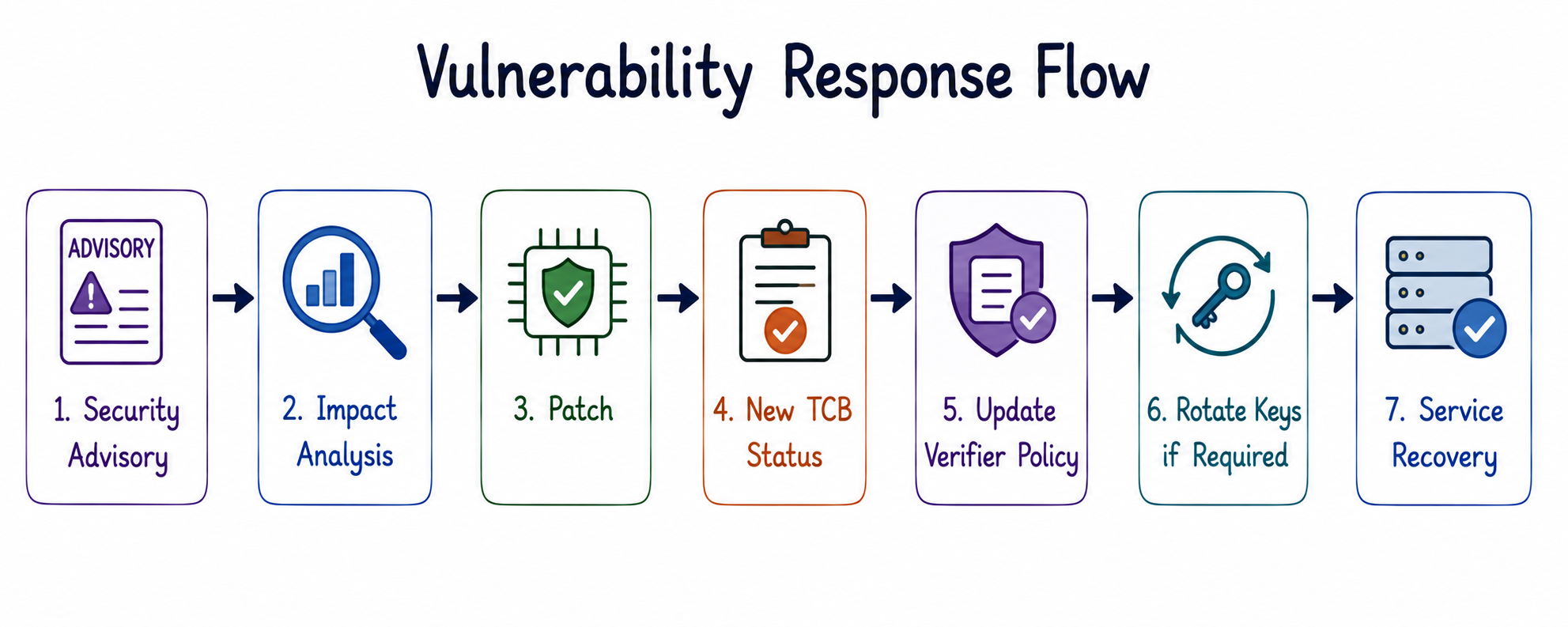
When an advisory appears:
1. Identify affected hardware. 2. Identify affected workload versions. 3. Determine attacker requirements. 4. Determine affected property. 5. Find vendor mitigation. 6. Check performance impact. 7. Update policy. 8. Patch and attest. 9. Rotate secrets if required. 10. Record remaining risk.
Developer exercise
Choose one attack:
- Foreshadow
- Plundervolt
- CacheWarp
- SinkClose
Write:
1. Affected platform 2. Attacker capability 3. Failed assumption 4. Security property affected 5. Mitigation 6. Remaining risk 7. Required verifier-policy change
Common mistakes
Key takeaways
- Hardware trust is an assumption.
- Microarchitectural and fault attacks can bypass expected boundaries.
- Firmware and microcode are part of the TCB.
- Patching may change attestation status.
- Vulnerability response must connect patches, policy, measurements, and keys.
- TEE security requires continuous maintenance.
Check your understanding
1. How does transient execution differ from normal architectural execution? 2. What property did Plundervolt attack? 3. Why is microcode part of the TCB? 4. Why must verifier policy change after some patches? 5. What costs come with hardware diversity?
Answer the quiz correctly to continue →
The Foreshadow attack showed that Intel SGX memory isolation can be bypassed using transient execution. What is the fundamental lesson for TEE system designers?