Choose the Right TEE Architecture
What you will learn
This lesson teaches you how to select between:
- Process-level enclaves
- Confidential virtual machines
- Isolated enclave VMs
- Secure-world systems
- Confidential containers
- Confidential accelerators
Begin with the required boundary
The first architectural question is:
> What is the smallest useful unit that needs protection?
Possible answers include:
- One cryptographic operation
- One application function
- One process
- One container workload
- One virtual machine
- One mobile security service
- One CPU and GPU workload
The size of the protected boundary affects:
- Trusted Computing Base
- Developer effort
- Compatibility
- Attestation
- Memory use
- I/O design
- Update process
- Side-channel surface
- Recovery process
Process-level enclave
A process enclave protects selected code and data.
This model is suitable when:
- Only a small part of the application is sensitive.
- The application can be split cleanly.
- A smaller TCB is important.
- Developers can manage a specialized interface.
The host remains responsible for ordinary services such as networking, storage, and scheduling. The protected code should treat all host responses as untrusted.
Example use cases
- Transaction signing
- Password verification
- Key derivation
- Private matching
- Credential processing
- Tokenization
Confidential virtual machine
A confidential VM protects a full guest environment.
It is suitable when:
- Existing applications must run with limited changes.
- A full Linux environment is required.
- Several services need to run together.
- Process-level partitioning would be too expensive.
The guest kernel and guest services are normally inside the trusted boundary.
AMD describes SEV as a VM-based confidential-computing system. SEV-ES protects guest register state during exits, while SEV-SNP adds memory-integrity and page-ownership protections intended to resist malicious hypervisor remapping and replay.
Example use cases
- Private databases
- Enterprise workloads
- Confidential AI services
- Data clean rooms
- Existing microservices
- Complete blockchain nodes
Isolated enclave VM
An isolated enclave VM sits beside a parent workload and exposes restricted interfaces.
AWS Nitro Enclaves allocates isolated CPU and memory from a parent EC2 instance. The enclave has no normal persistent storage or external networking and communicates with its parent through a local virtual socket. It can request signed attestation documents from the Nitro Hypervisor.
This architecture is suitable for:
- Key operations
- Signing services
- Private comparison
- Tokenization
- Decryption services
- Small confidential backends
Confidential container
A confidential container places a container workload inside a confidential VM.
It is useful when:
- The team already uses Kubernetes.
- Existing container images should be reused.
- Workload deployment should remain cloud-native.
- The team accepts the guest environment in the TCB.
Confidential Containers separates the workload guest from the untrusted host and uses attestation services, reference values, policy, and a Key Broker Service for resource release.
Confidential accelerator
A confidential accelerator extends the trusted execution path to a GPU or another PCIe device.
The architecture may need to protect:
- CPU workload
- Device firmware
- Driver
- Device memory
- CPU-to-device communication
- Device attestation
- Model weights
- Input and output buffers
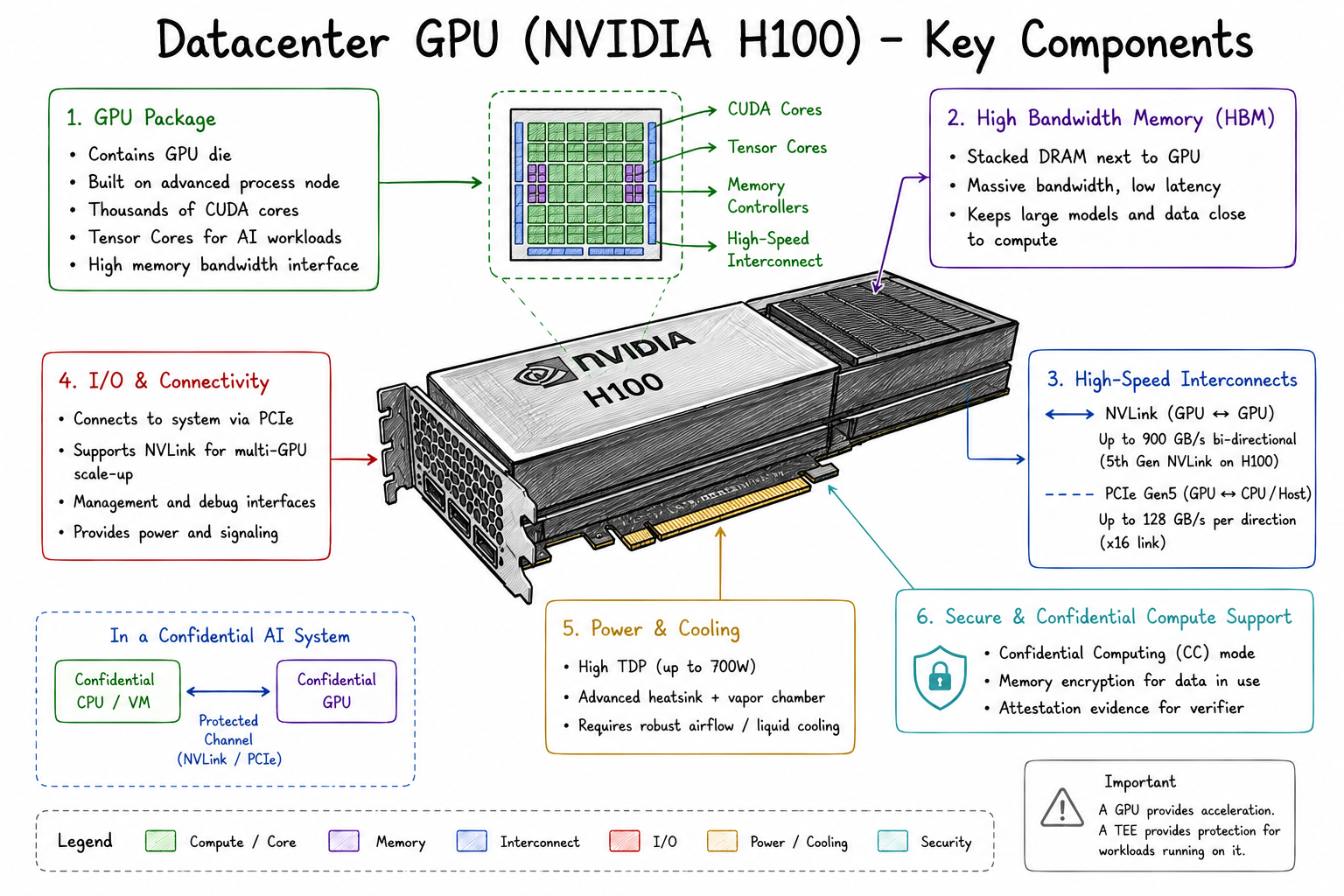
This option is relevant to:
- Large AI models
- Private model inference
- Confidential training
- Scientific workloads
- High-volume analytics
The trust boundary becomes more complex because it spans multiple processors and firmware systems.
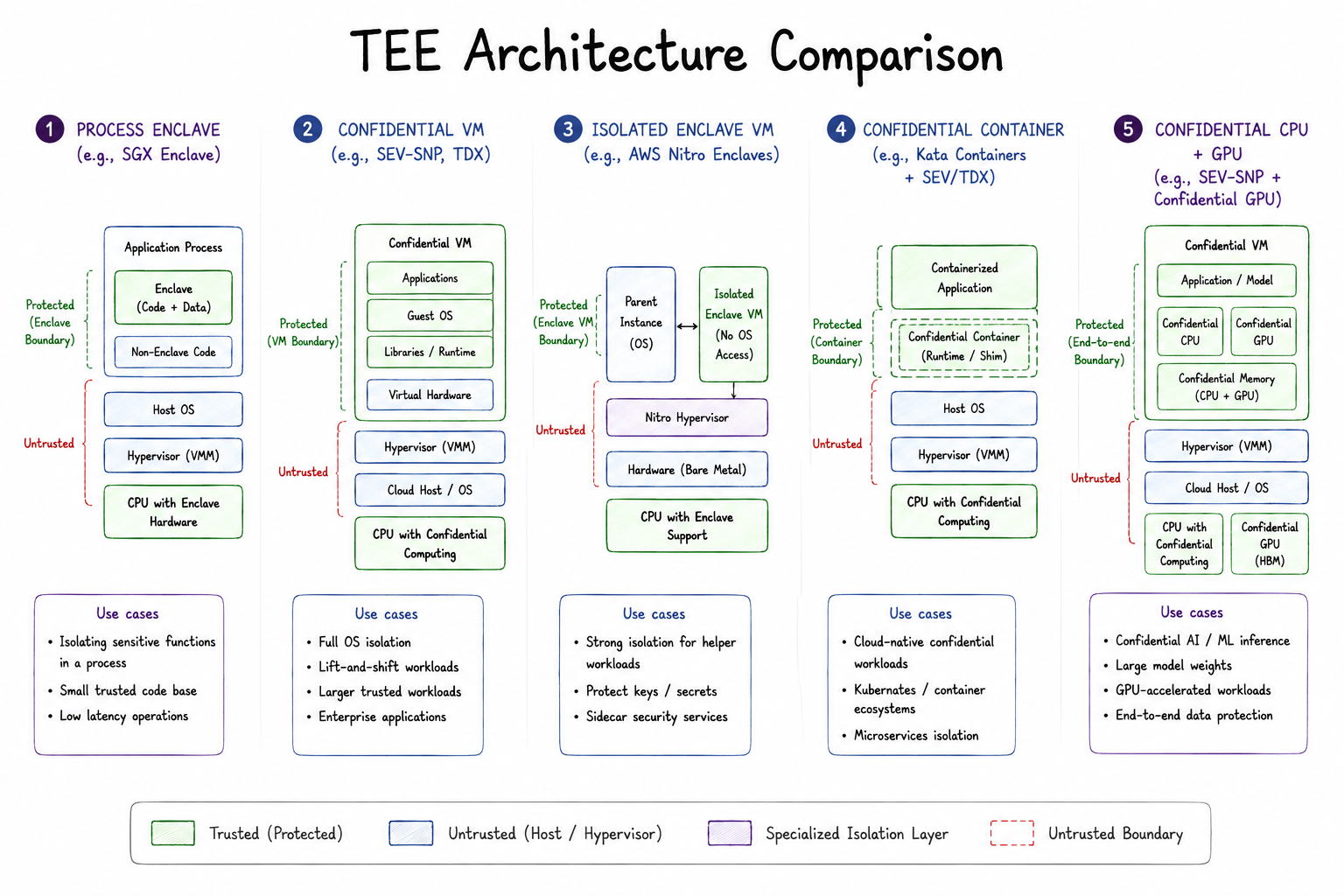
Architecture-selection questions
Ask the following before choosing a platform.
How much code needs protection?
A 500-line key service may fit a process enclave. A large database and API stack may fit a confidential VM more naturally.
Can the application be rewritten?
Process enclaves often require application partitioning. Confidential VMs may support existing applications with fewer changes.
What is the acceptable TCB?
A full guest kernel introduces more trusted code. A process enclave introduces a smaller boundary but may depend on an enclave runtime and more host calls.
What I/O is required?
Ask whether the protected workload needs:
- Direct network access
- File access
- Persistent storage
- GPU access
- Multiple processes
- Dynamic libraries
- System services
- Kubernetes integration
How will attestation work?
Check:
- Evidence format
- Certificate chain
- Verification libraries
- Reference values
- Debug-mode claims
- Revocation
- Offline verification
- Vendor service dependencies
How will the application be updated?
Determine whether identity is bound to:
- Exact measurement
- Signer
- Image certificate
- Security version
- Container image
- Guest firmware
Is simulation available?
A simulator is useful for development. A simulator does not provide real hardware isolation or hardware-backed attestation. Do not use successful simulation as evidence that the system is secure on production hardware.
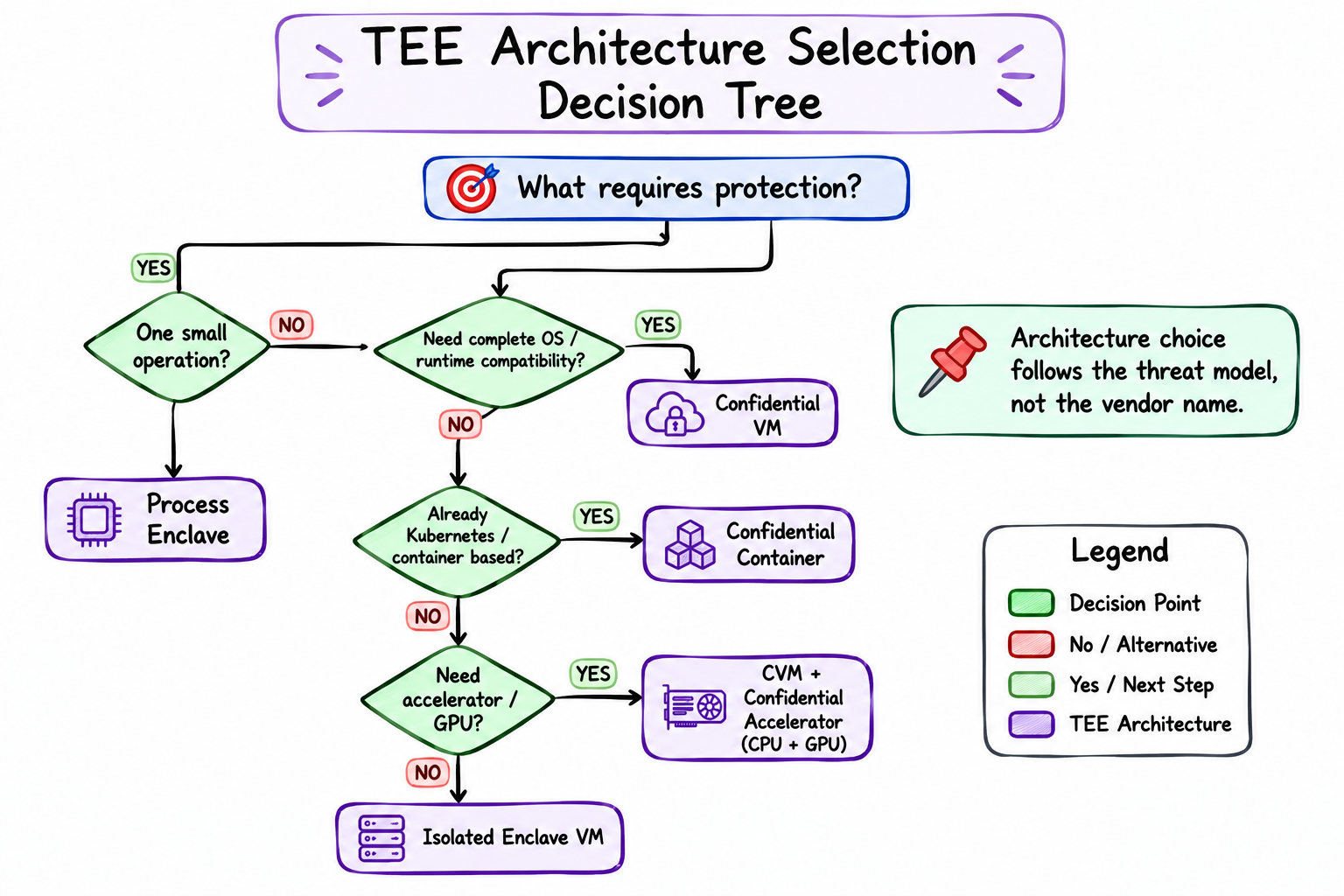
Selection example: Private API-key service
The service must:
- Store API keys
- Release a key only to an approved operation
- Handle fewer than ten operations
- Expose one narrow API
- Run on a cloud server
A process enclave or isolated enclave VM may be a reasonable starting point. A complete confidential VM could work, but it would place more software inside the trusted boundary.
Selection example: Existing AI platform
The system includes:
- Python
- Model runtime
- CUDA libraries
- Several services
- Large model files
- Monitoring agents
A confidential VM combined with a confidential accelerator may require fewer changes than rewriting the entire system into a small enclave. The larger TCB should be recorded and reviewed.
Developer exercise
Choose an architecture for each use case:
1. Validator signing key 2. Private SQL analytics 3. Mobile biometric check 4. Confidential LLM inference 5. Private auction matcher 6. Kubernetes-based document processor
For each choice, explain:
- Protected boundary
- Trusted components
- Required application changes
- Attestation method
- Main remaining risk
Common mistakes
Key takeaways
- Select the smallest boundary that supports the workload.
- Process enclaves reduce TCB size but increase partitioning work.
- Confidential VMs increase compatibility but trust the guest environment.
- Confidential containers adapt VM-level TEEs to container workflows.
- Confidential accelerators create a multi-device trust chain.
- Measure performance and compatibility on the actual platform.
Check your understanding
1. Why can a confidential VM have a larger TCB than a process enclave? 2. When is application compatibility more important than minimum TCB size? 3. Why is a simulator not a security environment? 4. Which new components enter the trust model with a confidential GPU? 5. Why should platform selection follow the threat model?
Answer the quiz correctly to continue →
A team needs to protect a 500-line key-signing service against a malicious cloud host. Which TEE architecture minimizes the Trusted Computing Base while keeping integration effort manageable?