Completeness, Soundness, Zero-Knowledge
Every ZK proof makes three guarantees
A zero-knowledge proof is not just a clever trick. It is a mathematical construction that must satisfy three formal properties to be considered valid. These properties are what separate a real ZK proof from someone just saying "trust me, I know."
You already saw all three in action in the cave. Now let's name them.
The three properties
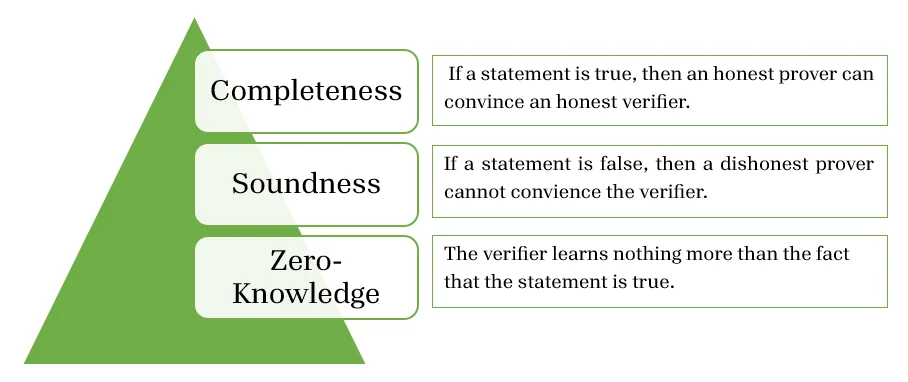
Completeness means that if you are telling the truth, you will always be able to convince the verifier. An honest prover with a genuine secret will never fail. In the cave, Peggy always exits from the correct tunnel when she knows the word. Every single round. No exceptions.
Soundness means that if you are lying, you will almost certainly get caught. A dishonest prover cannot fake their way through consistently. In the cave, someone without the secret word has a 50% chance of surviving one round and a near-zero chance of surviving ten. The math makes cheating statistically impossible, not just difficult.
Zero-knowledge means the verifier learns nothing beyond the single fact being proved. Victor watches Peggy walk in and out of that cave dozens of times and still has no idea what the secret word is. The proof reveals the truth of the claim without revealing anything that produced it.
Why all three matter together
Remove any one of them and the system breaks in a specific way.
Without completeness, honest people get falsely rejected. A real credential holder cannot prove they are legitimate. The system becomes unreliable.
Without soundness, dishonest people get falsely accepted. A fraudster can claim anything and eventually pass. The system becomes worthless.
Without zero-knowledge, the proof works but privacy is gone. You can verify the claim but only by learning the secret behind it. You are back to the old world where proving something means revealing everything.
Real ZK systems are designed to satisfy all three properties simultaneously. That combination is what makes them genuinely useful rather than just theoretically interesting.
Answer the quiz correctly to continue →
Match each ZK property to its correct definition.