From Model to Agent
The problem with the word "agent"
In 2023, "agent" mostly meant a model that could call a function. Since then it has been attached to autocomplete, customer support widgets, research pipelines, and processes that hold private keys and move money without a human in the loop.
These are not variations on a theme. They are different machines, with risk profiles that differ by orders of magnitude.
Any serious analysis has to define agency along a continuum, not as a binary.
Single-turn inference
Start with a model answering a question.
You send text. It returns text. Nothing else happens. No memory of previous calls, no ability to reach outside the request. A human reads the output and decides what to do.
Call this single-turn inference.
It has privacy questions — your input passed through someone else's server, it may be logged. But it has almost no agency concerns for one reason:
It cannot do anything. The worst outcome is a wrong answer. A human still stands between the model and the world.
Adding a tool
Now we change one thing. We tell the model: if you need current information, you may call this search function.
`` input → model → tool call → tool result → model → output ``
Something important just happened.
The model's output is no longer only read by a human. Part of its output is now read by a machine that will act on it.
When the model emits a tool call, code parses it and executes it. If the tool is a search, a search happens. If it were a payment API, money would move.
We have crossed from a system that produces text to a system that produces effects.
This is a tool-using agent.
The loop
Real tool use is rarely one call. The model calls a tool, sees the result, and decides what to do next. Eventually it decides it is done.
That pattern — reason, act, observe, repeat — is the core loop of nearly every agent framework in production.
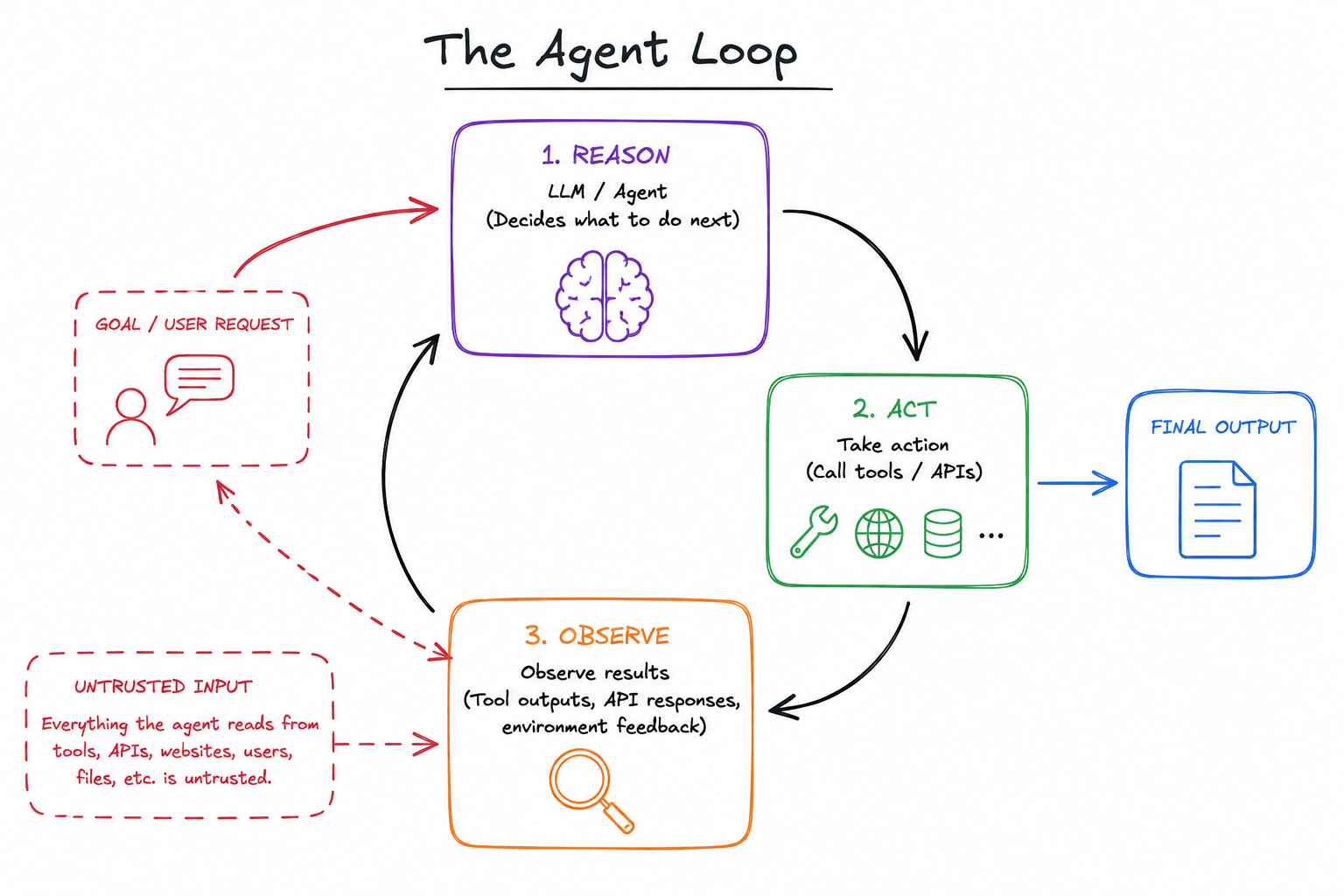
The point where tool results re-enter the model is the most security-relevant part of this diagram. That re-entry point is untrusted input — and Stage 2 of this course is entirely about it.
What changes when there is a loop
A single tool call is inspectable. You could imagine reading it before it runs.
A loop is not.
- The number of steps is unknown in advance
- The sequence depends on what tools return
- The same task run twice may take different paths
- The model is stochastic — you cannot fully predict the path even knowing all inputs
The system has acquired a property ordinary software does not have:
You cannot enumerate its possible behaviours before it runs.
That is not a flaw — it is the point of the design. It is also why reviewing agent behaviour after the fact is such a weak security strategy.
Key takeaways
- "Agent" describes a range, not a category. Same word, wildly different risk.
- Single-turn inference cannot act. A human stands between the model and the world.
- The threshold is crossed when a machine reads the model's output and acts on it.
- The loop makes behaviour unenumerable in advance — which is why prevention beats review.
Answer the quiz correctly to continue →
What is the key threshold that separates a tool-using agent from single-turn inference?